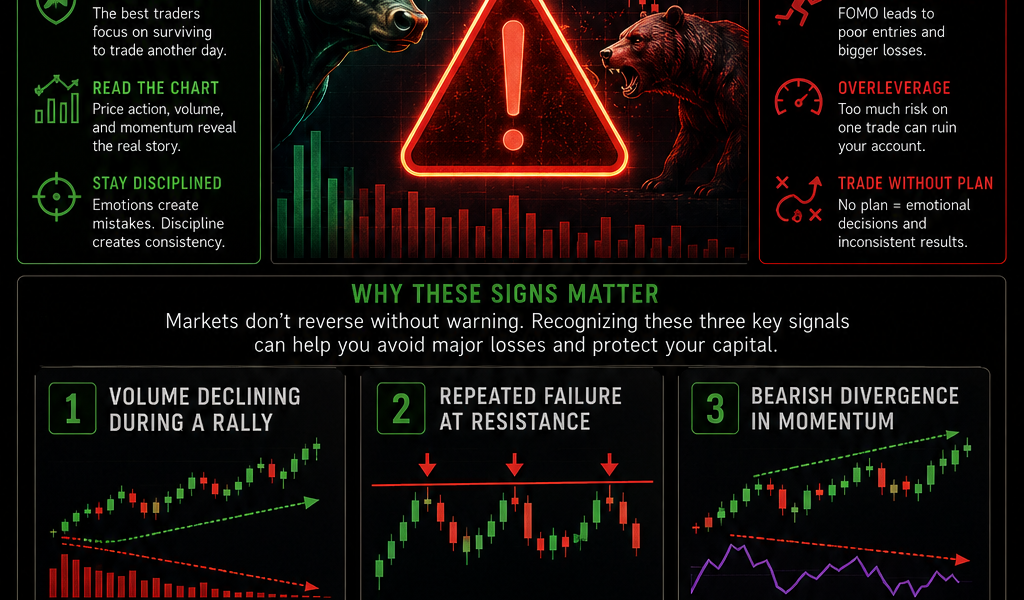
3 Warning Signs Every Investor Should Know
Successful traders and investors spend a great deal of time searching for opportunities, but the best market participants are equally focused on identifying danger. While nobody can predict every market move, there are several warning signs that frequently appear before significant losses occur. Learning to recognize these signals can help investors protect their capital and avoid costly mistakes.
Whether you trade stocks, cryptocurrencies, commodities, or forex, understanding these warning signs can improve your decision-making and help you approach the markets with greater confidence.
1. Price Rises While Volume Falls
One of the most important relationships in technical analysis is the connection between price and volume. Volume measures the number of shares, contracts, or coins being traded over a given period. It provides insight into the strength behind a market move.
In a healthy uptrend, rising prices are usually accompanied by increasing volume. This suggests that buyers are actively supporting the move and that demand is strong. However, problems can arise when prices continue to climb while trading volume gradually declines.
This situation often indicates that fewer participants are willing to buy at higher prices. The trend may still appear strong on the surface, but the lack of participation suggests that momentum is weakening. Eventually, a market can run out of buyers, leading to a correction or even a trend reversal.
Imagine a stock that rises from £50 to £70 over several weeks. During the early stages of the rally, volume is high as investors rush to buy. As the price approaches £70, volume begins to decline even though the stock continues to rise. This divergence can be an early warning that the trend is losing strength.
Volume should never be viewed in isolation, but when declining volume accompanies rising prices, it deserves attention.
2. Repeated Failure at Key Resistance Levels
Support and resistance are among the most widely used concepts in technical analysis. Resistance is an area where selling pressure has previously been strong enough to prevent prices from moving higher. When a market approaches resistance, traders watch closely to see whether buyers have enough strength to push through the level. A successful breakout often signals the continuation of an uptrend. However, repeated failures at the same resistance level can be a warning sign.
Each rejection suggests that sellers remain active and that buyers are struggling to gain control. If a market tests resistance multiple times without breaking through, confidence among buyers may begin to weaken. For example, imagine Bitcoin repeatedly approaches a major resistance level at $120,000 but fails to close above it. Each rejection encourages more traders to take profits or open short positions. Eventually, the market may pull back as selling pressure increases.
This does not mean that every resistance level will hold forever. Many markets eventually break through resistance and continue higher. However, repeated failures often indicate that caution is warranted until buyers demonstrate clear strength. When analysing charts, pay attention not only to the resistance level itself but also to how price behaves around it. Long upper wicks, bearish candlestick patterns, and declining momentum can all reinforce the warning.
3. Momentum Indicators Diverge from Price
Momentum indicators are designed to measure the speed and strength of price movements. Popular tools include the Relative Strength Index (RSI), Moving Average Convergence Divergence (MACD), and Stochastic Oscillator.
One of the most useful concepts involving momentum indicators is divergence. A bearish divergence occurs when price makes a higher high while the momentum indicator makes a lower high. In simple terms, the market is still rising, but the underlying strength behind the move is weakening.
For example, a cryptocurrency may climb from $2 to $4 and then push to $5. On the chart, the new high looks impressive. However, if the RSI fails to make a new high alongside price, it suggests that buying momentum is fading.
Divergences do not guarantee an immediate reversal. Markets can continue trending for some time despite weakening momentum. However, they often serve as an early warning that the trend may be approaching exhaustion. Many traders combine divergence analysis with support and resistance levels or volume analysis to build a stronger case for a potential reversal. The key is to view momentum indicators as a supporting tool rather than a standalone trading system.
Putting the Pieces Together
Each of these warning signs can provide valuable information on its own, but they become far more powerful when they appear together.
Imagine a market that is:
- Rising on declining volume
- Repeatedly failing at a major resistance level
- Showing bearish divergence on the RSI
Individually, none of these signals guarantee a reversal. Together, however, they paint a picture of a market that may be losing strength. Professional traders rarely rely on a single indicator. Instead, they look for multiple pieces of evidence that support a particular view. This approach helps reduce emotional decision-making and encourages a more disciplined trading process.
No warning sign is perfect, and no indicator can predict the future with complete accuracy. Markets are influenced by countless factors, including economic data, investor sentiment, and unexpected news events. learning to recognise declining volume, repeated resistance failures, and momentum divergences can help investors spot potential problems before they become major losses.
Successful investing is not just about finding winning trades. It is also about protecting capital when conditions become less favourable. By paying attention to these three warning signs, investors can improve their market awareness and make more informed decisions. Preserving capital during difficult periods is often what allows traders and investors to take advantage of the next great opportunity.
