Bollinger Bands
Bollinger Bands are one of the most widely used technical analysis tools for understanding volatility in the market. Unlike indicators that focus only on direction, Bollinger Bands help traders see how expanding or contracting volatility often comes before big price moves happen .
In simple terms, they answer two key questions:
- Is the market calm or volatile?
- Is a big move likely to happen soon?
What Are Bollinger Bands ?
Bollinger Bands consist of three lines plotted on a price chart:
- Middle Band → a moving average (usually 20-period SMA)
- Upper Band → the moving average plus a volatility buffer
- Lower Band → the moving average minus a volatility buffer
These bands automatically expand and contract based on market volatility.
When volatility increases, the bands widen.
When volatility decreases, the bands tighten.
This dynamic nature makes them very useful for spotting changing market conditions.
The Core Idea: Volatility Measurement
Unlike indicators such as RSI or MACD, Bollinger Bands do not directly show direction.
Instead, they measure:
- How much price is moving (volatility)
- Whether the market is expanding or consolidating
This is important because markets often alternate between:
- Periods of low volatility (consolidation)
- Periods of high volatility (breakouts)
Bollinger Bands help visualise this cycle clearly.
Understanding Price Interaction With the Bands
Price behaves differently depending on market conditions:
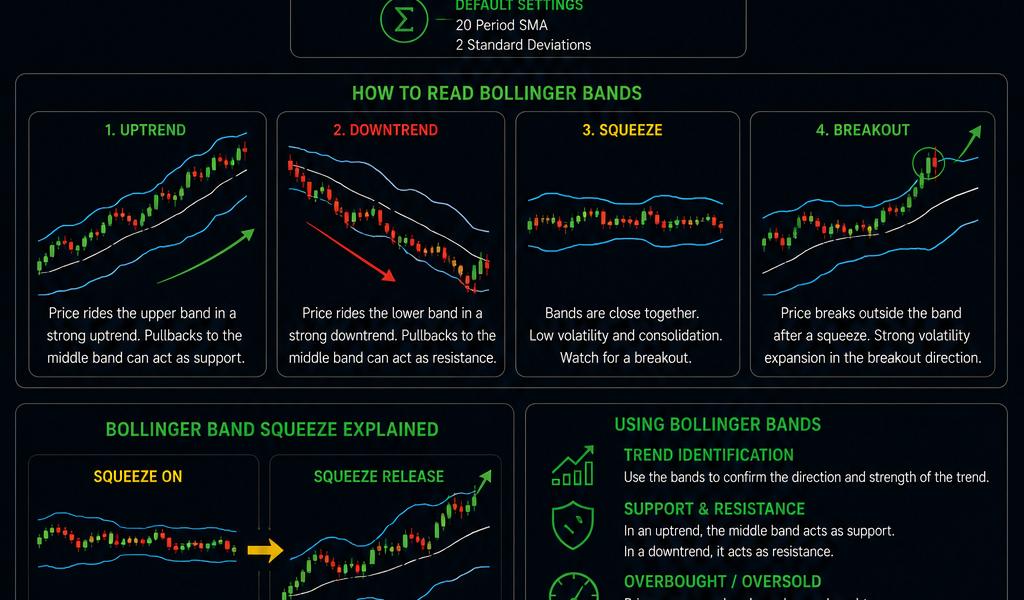
In a Strong Uptrend:
- Price often rides the upper band
- Pullbacks stay near the middle band
- Upper band acts as dynamic resistance/support
In a Strong Downtrend:
- Price often stays near the lower band
- Rallies struggle to break the middle band
- Lower band acts as dynamic pressure zone
This helps traders understand whether momentum is bullish or bearish.
What Is a Bollinger Band Squeeze ?
The squeeze is one of the most important concepts in this indicator.
It occurs when:
- Upper and lower bands move very close together
- Volatility drops significantly
- Price consolidates in a tight range
This signals that the market is “coiling” before a potential big move.
Think of it like a spring being compressed — the more it tightens, the stronger the potential breakout.
Why Squeezes Matter
A squeeze does not tell you direction — it tells you that a large move is likely coming soon.
During a squeeze:
- Market uncertainty is high
- Buyers and sellers are balanced
- Volatility is low
Eventually, one side gains control and price breaks out.
The breakout can happen either:
- Upward (bullish breakout)
- Downward (bearish breakdown)
How Traders Use Squeezes
Traders often look for confirmation after a squeeze:
Bullish Breakout Setup:
- Bands tighten (squeeze)
- Price breaks above upper band
- Volume increases
- Momentum indicators confirm strength
Bearish Breakdown Setup:
- Bands tighten (squeeze)
- Price breaks below lower band
- Volume increases
- Momentum weakens
The squeeze itself is not the trade — the breakout is.
Bollinger Bands and Overbought/Oversold Conditions
Another common use of Bollinger Bands is identifying stretched price moves.
- Price near upper band → potentially overbought (not always a sell signal)
- Price near lower band → potentially oversold (not always a buy signal)
In strong trends, price can “walk the band” for long periods, meaning it stays near one side while continuing in the same direction.
Bollinger Bands vs Volatility Regimes
Bollinger Bands help identify two key market states:
1. Low Volatility (Squeeze)
- Bands contract
- Price moves sideways
- Breakout is building
2. High Volatility (Expansion)
- Bands widen
- Strong directional move begins
- Trends develop
Understanding this shift helps traders avoid false entries during quiet periods.
Common Mistakes Traders Can Make
1. Trading every touch of the bands
Price touching a band does not automatically mean reversal.
2. Ignoring trend context
In strong trends, price can stay near one band for long periods.
3. Trading squeezes too early
The squeeze itself is not the signal — breakout confirmation is essential.
Combining Bollinger Bands With Other Tools
Bollinger Bands work best when combined with:
- RSI → confirms overbought/oversold conditions
- Volume → confirms breakout strength
- Support and resistance → identifies key breakout zones
- Candlestick patterns → improves timing entries
- MACD → confirms momentum direction
Example:
- Bollinger Band squeeze forms
- Price breaks upper band
- RSI rises above 50
- Volume increases
→ stronger bullish breakout setup
Simple Way to Think About Bollinger Bands
You can simplify them into three ideas:
- Bands wide → market is volatile
- Bands tight → market is coiling
- Breakout → volatility expansion begins
Bollinger Bands are a powerful tool for understanding market volatility and identifying potential breakout conditions.
Rather than predicting direction, they help traders see when the market is preparing for a move and when momentum is likely to expand. The squeeze is especially valuable because it often comes before significant price movements, giving traders insight into periods of hidden pressure building in the market.
When combined with confirmation tools like volume, RSI, and support/resistance, Bollinger Bands become a strong framework for spotting high-probability trading setups in both trending and ranging markets.
