Understanding Stochastic And Momentum
Developed by George Lane during the 1950s, the indicator helps traders identify potential trend reversals, overbought conditions, and oversold market opportunities. Despite its relatively simple appearance, the stochastic oscillator remains a powerful tool used by beginners and professional traders alike across forex, stocks, crypto, and commodities markets.
At its core, stochastic analysis measures momentum rather than price direction itself. The theory behind the indicator is based on the idea that momentum often changes before price does. In strong upward trends, prices tend to close near the top of their recent trading range, while in downward trends, prices usually close near the bottom of the range. By comparing a closing price to its recent range, traders can gain insights into potential shifts in market strength.
What Is the Stochastic Oscillator?
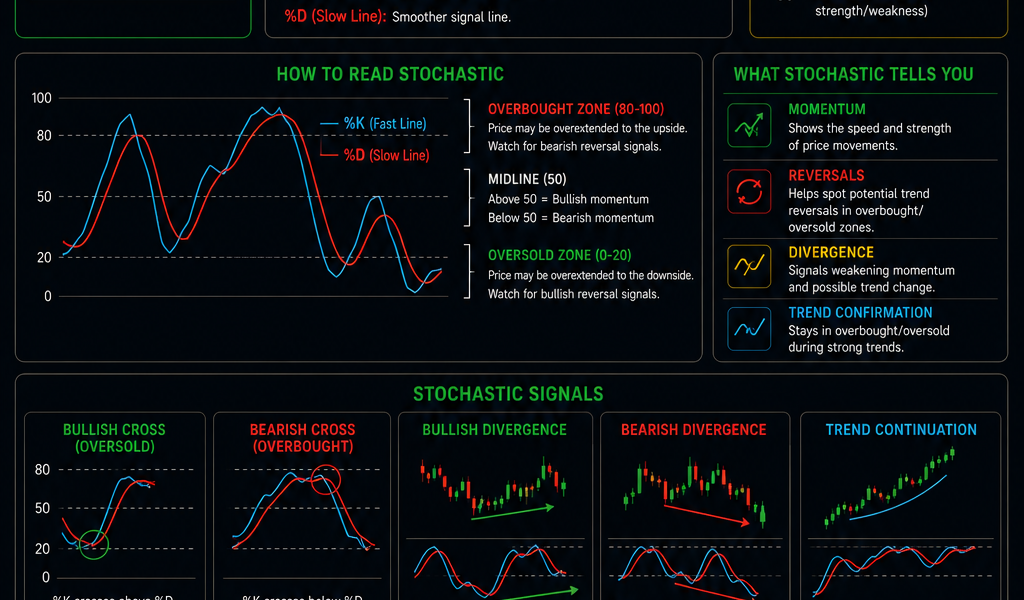
The oscillator is displayed as two lines moving between values of 0 and 100:
- %K Line – the main stochastic line
- %D Line – a moving average of the %K line
The indicator is usually plotted beneath a price chart and is designed to highlight momentum extremes. Values above 80 are generally considered overbought, while values below 20 are viewed as oversold.
The basic formula is:
\%K = \frac{(C-L_{14})}{(H_{14}-L_{14})} \times 100
Where:
- C = current closing price
- L14 = lowest low over the last 14 periods
- H14 = highest high over the last 14 periods
This formula creates a momentum reading showing where the current close sits relative to the recent trading range.
The %D line is usually a simple moving average of the %K line and acts as a signal line for traders.
Understanding Overbought and Oversold Conditions
One of the main uses of this particular oscillator is identifying overbought and oversold conditions.
When the stochastic rises above 80, it suggests that buying momentum may be overextended. This does not necessarily mean the market will immediately reverse, but it can indicate that bullish momentum is slowing.
Similarly, readings below 20 suggest the market may be oversold, meaning sellers could be losing control and a bounce may become possible.
Traders should remember that markets can remain overbought or oversold for extended periods during strong trends. This is why the signals are often combined with price action, support and resistance levels, or additional indicators for confirmation.
Crossovers
Crossovers between the %K and %D lines are among the most commonly used trading signals.
A bullish crossover occurs when the %K line rises above the %D line, especially in oversold territory below 20. Traders may interpret this as a signal that momentum is shifting upward.
A bearish crossover occurs when the %K line drops below the %D line, particularly in overbought territory above 80. This can suggest weakening bullish momentum and a possible downward move.
Many traders wait for the crossover candle to close before entering trades to avoid reacting to temporary market fluctuations.
Divergence Signals
Divergence is another important concept in stochastic analysis. Divergence occurs when price movement and the stochastic oscillator move in opposite directions.
Bullish Divergence
A bullish divergence happens when price forms lower lows while the stochastic forms higher lows. This may indicate that bearish momentum is weakening even though price is still falling.
Bearish Divergence
A bearish divergence occurs when price creates higher highs but the stochastic forms lower highs. This can signal that buying momentum is fading and a reversal may be approaching.
Divergence does not always lead to an immediate reversal, but it can provide an early warning sign that market momentum is changing.
Fast, Slow, and Full Stochastics
There are several versions of the stochastic oscillator, each designed to suit different trading styles.
Fast
The fast stochastic reacts quickly to price movement and generates more trading signals. While it can provide earlier entries, it may also create more false signals in volatile markets.
Slow
The slow stochastic smooths out price action using additional averaging. This version is generally considered more reliable and is widely used by swing traders.
Full
The full stochastic allows traders to customize smoothing settings and sensitivity levels. Advanced traders often prefer this version because it provides greater flexibility.
Best Market Conditions for Stochastic Analysis
The oscillator works best in ranging or sideways markets where prices regularly swing between support and resistance levels. In these conditions, overbought and oversold signals can help traders identify potential turning points.
During strong trending markets, however, stochastic signals can become less reliable. An uptrend may remain overbought for long periods, while a downtrend may stay oversold longer than expected.
To improve accuracy, many traders combine stochastic analysis with trend indicators such as moving averages or the Moving Average Convergence Divergence.
For example:
- Use moving averages to identify the overall trend
- Use stochastic pullbacks for entries within that trend
- Combine stochastic signals with support and resistance zones
- Confirm reversals using candlestick patterns
This multi-layered approach can reduce false signals and improve trade quality.
Common Trading Strategies
Trend Pullback Strategy
In an uptrend, traders may wait for the stochastic to fall below 20 before looking for bullish crossovers. This approach aims to enter trades during temporary pullbacks within a larger upward trend.
Range Trading Strategy
When markets move sideways, traders can use stochastic readings near 80 and 20 to identify potential reversal zones between resistance and support.
Divergence Strategy
Some traders focus primarily on bullish and bearish divergence patterns, using them as early warnings of possible trend reversals.
Limitations of the Stochastic
False signals can occur frequently, especially in volatile or trending markets. Traders who rely solely on stochastic readings without considering broader market structure may enter trades too early.
Another limitation is that stochastic analysis does not predict the size or duration of a move. It simply measures momentum relative to recent price action.
Risk management remains essential. Stop-loss placement, position sizing, and confirmation from other tools can help reduce trading risk.
The stochastic oscillator remains one of the most effective momentum indicators in technical analysis because of its simplicity and versatility. Whether used for spotting overbought conditions, identifying momentum shifts, or detecting divergence, the indicator can provide valuable insights into market behaviour.
While no indicator guarantees success, stochastic analysis can become a powerful addition to a trader’s strategy when combined with trend analysis, price action, and proper risk management.
Understanding how momentum behaves within different market conditions allows traders to make more informed decisions and improve timing in both short-term and long-term trading environments.
