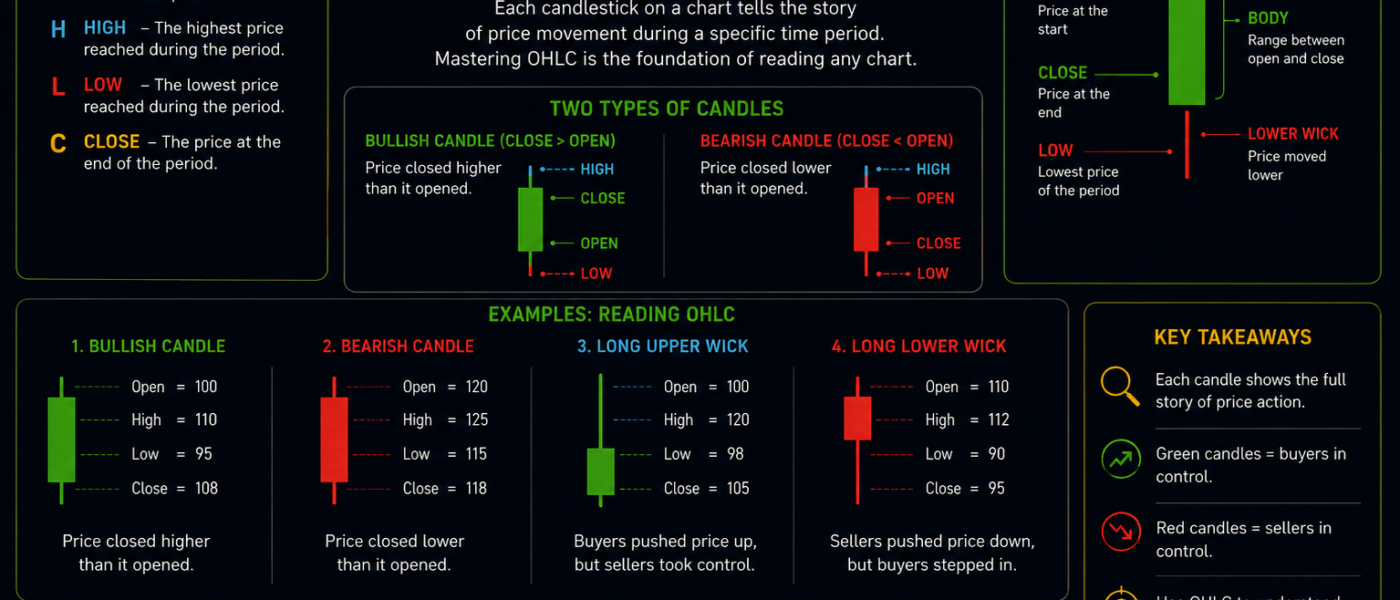
How to Read OHLC (Open, High, Low, Close) and Wicks
If you are new to trading charts, one of the first things you will come across is the OHLC candle. Understanding how to read these candles is an important step for anyone interested in stocks, forex, crypto, or commodities. Candlestick charts may look complicated at first, but once you understand the basics, they become one of the easiest ways to read market behaviour.
OHLC stands for Open, High, Low, and Close. These four prices tell you what happened during a selected time period. That period could be one minute, one hour, one day, or even one week depending on the chart settings.
What Does OHLC Mean?
Every candlestick on a chart represents four important prices:
- Open – The price where the asset started trading during that time period.
- High – The highest price reached during the period.
- Low – The lowest price reached during the period.
- Close – The final price when the candle finished.
For example, on a 1-hour chart, each candle shows the open, high, low, and close price for that hour. The body and wicks of the candle visually display this information.
Understanding How To Read OHLC and The Candle Body
The thick middle section of the candle is called the body. The body shows the difference between the open and close prices. If the closing price is higher than the opening price, the candle is usually coloured green or white. This is known as a bullish candle because the price increased. If the closing price is lower than the opening price, the candle is usually coloured red or black. This is known as a bearish candle because the price decreased.
Here is a simple example:
- Bitcoin opens at £50,000
- Price rises to £51,200
- Falls to £49,700
- Closes at £50,800
Because the closing price is higher than the opening price, the candle would normally appear green.
What Are Wicks?
The thin lines above and below the candle body are called wicks, sometimes referred to as shadows.
Wicks show how far the price moved outside the opening and closing prices during that time period.
- The top wick shows the highest price reached.
- The bottom wick shows the lowest price reached.
Wicks are extremely important because they reveal market rejection and trader behaviour.
For example, a long upper wick can show that buyers pushed the price higher, but sellers forced it back down before the candle closed. This may suggest resistance or weakening momentum. A long lower wick can show that sellers pushed the price down, but buyers stepped in and pushed it back up before closing. This may suggest support or buying pressure.
Why Wicks Matter in Trading
Many beginner traders focus only on whether a candle is green or red, but experienced traders often pay close attention to the wicks.
Wicks can provide clues about:
- Market indecision
- Reversals
- Support and resistance levels
- Buyer and seller strength
- Stop-loss hunting
For example, if you see repeated long wicks rejecting the same price level, it may indicate a strong support or resistance zone. In crypto trading especially, large wicks are common because of volatility and sudden price movements.
Common Wick Patterns
Long Upper Wick
A long upper wick means price moved significantly higher but could not stay there. Sellers entered the market and pushed the price back down.
This can signal:
- Potential bearish reversal
- Strong resistance
- Weakening buying pressure
Long Lower Wick
A long lower wick means price dropped lower but buyers pushed it back up before the candle closed.
This can signal:
- Potential bullish reversal
- Strong support
- Buyer strength
Small or No Wicks
Candles with almost no wicks show strong momentum in one direction. A strong bullish candle with little or no lower wick suggests buyers were in control throughout the entire period. A strong bearish candle with little or no upper wick suggests sellers dominated trading.
Using OHLC and Wicks Together
The real skill comes from reading candles in context rather than individually.
For example:
- A long lower wick near a support level may indicate a bounce.
- A long upper wick after a strong rally could suggest exhaustion.
- Multiple candles rejecting the same level can highlight important market zones.
Traders combine OHLC analysis with trend lines, volume, moving averages, and support and resistance to make better decisions.
Learning to read OHLC candles and wicks is one of the foundations of technical analysis. Every candle tells a story about the battle between buyers and sellers during a specific time period.The candle body shows where price opened and closed, while the wicks reveal how far price moved and whether those moves were rejected.
Although no candlestick pattern guarantees future movement, understanding OHLC and wick behaviour can help traders read market sentiment more clearly and make more informed decisions. With practice, candlestick charts become much easier to understand, and you will begin spotting patterns and market behaviour naturally over time.
