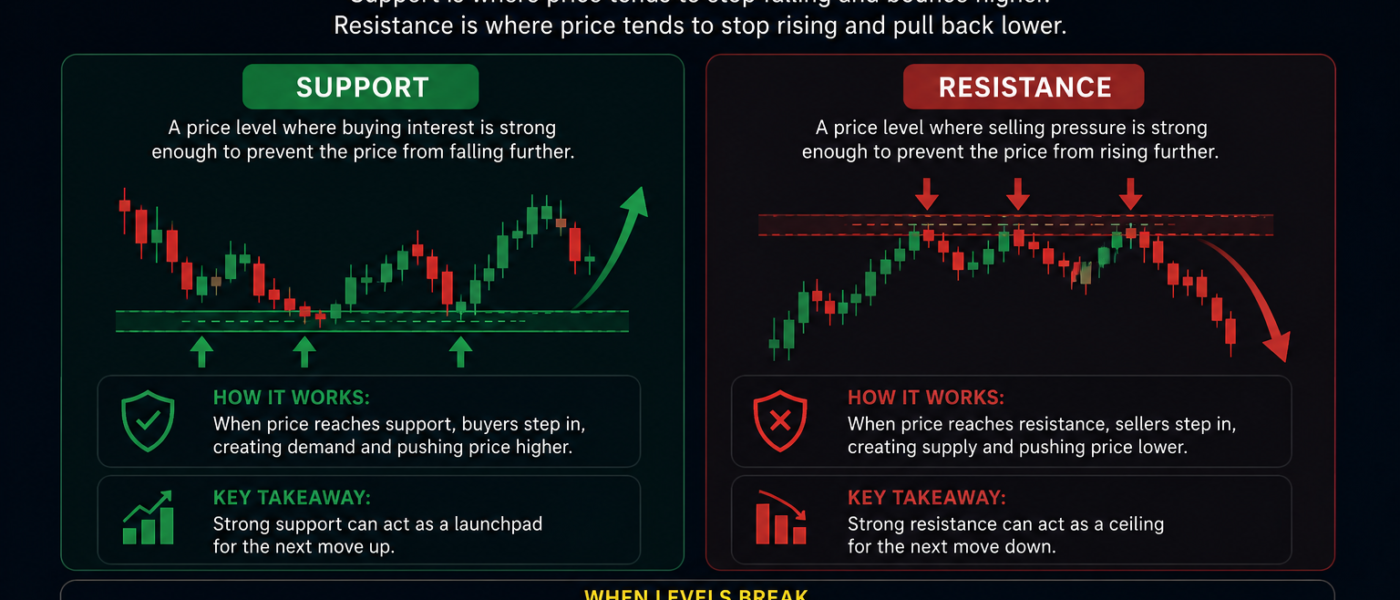
Support And Resistance
Identifying “Floors” and “Ceilings” on a Chart
One of the most important concepts in any form of technical analysis is understanding support and resistance. These levels act like invisible barriers on a trading chart and are used by traders in stocks, forex, and cryptocurrency markets to predict possible price movements.
If you have ever heard traders talk about “buying at support” or “selling at resistance,” they are referring to areas where price historically struggles to move beyond.
In simple terms:
- Support is the “floor” of the market.
- Resistance is the “ceiling” of the market.
Learning how to identify these levels can help traders improve entries, exits, stop-loss placement, and overall market awareness.
What Is Support?
Support is a price level where an asset tends to stop falling and may begin moving upward again.
This happens because buyers believe the price is cheap or good value at that level, increasing buying pressure.
Imagine dropping a ball onto the floor. The floor stops the ball from falling further and causes it to bounce. Support works in a similar way on a trading chart.
For example:
- Bitcoin falls several times toward £50,000
- Buyers repeatedly step in at that level
- Price bounces upward each time
This suggests that £50,000 is acting as a support level.
The more times price respects a support zone without breaking below it, the stronger that support may become.
What Is Resistance?
Resistance is the opposite of support. It is a price level where an asset struggles to move higher.
At resistance levels, sellers often enter the market because they believe the asset is overvalued or ready for a pullback.
Using the ball example again, resistance acts like a ceiling that prevents the ball from rising further.
For example:
- Ethereum repeatedly rises toward £3,000
- Sellers enter the market each time
- Price gets rejected and moves lower
This suggests that £3,000 is acting as resistance.
The more times price fails to break above resistance, the more important the level may become.
Why Support and Resistance Matter
Support and resistance levels are important because markets often react strongly around them.
Traders use these zones to:
- Identify possible entry points
- Set profit targets
- Place stop-losses
- Spot breakout opportunities
- Understand market psychology
These levels work because many traders are watching the same areas. When large groups of traders react at similar price levels, the market naturally creates repeated patterns.
How to Identify Support and Resistance
The easiest way to identify support and resistance is to look for areas where price has reversed multiple times in the past.
Identifying Support
Look for:
- Areas where price repeatedly stops falling
- Multiple bounce points
- Long lower wicks showing buyer rejection
Identifying Resistance
Look for:
- Areas where price repeatedly stops rising
- Multiple rejection points
- Long upper wicks showing seller rejection
Instead of focusing on exact prices, traders often treat support and resistance as zones or areas.
This is because markets rarely reverse at the exact same number every time.
Support Becoming Resistance
One interesting feature of technical analysis is that support and resistance can switch roles.
When support breaks, it can become new resistance.
For example:
- Price holds above £100 several times
- Eventually price breaks below £100
- Later, price rises back toward £100
- Sellers reject the level
The old support has now become resistance.
The opposite can also happen:
- Resistance breaks
- Price moves higher
- The old resistance becomes new support
This is a common concept used in breakout trading strategies.
False Breakouts
Not every breakout is genuine. Sometimes price briefly moves above resistance or below support before reversing quickly.
This is known as a false breakout or fakeout.
False breakouts are common in volatile markets like cryptocurrency and can trap inexperienced traders.
Many traders wait for confirmation before entering trades, such as:
- A candle closing above resistance
- Increased trading volume
- A successful retest of the broken level
Combining Support and Resistance With Other Tools
Support and resistance become more powerful when combined with other forms of analysis, including:
- Trend lines
- Moving averages
- RSI indicators
- Volume analysis
- Candlestick patterns
For example, if a strong support level also lines up with an oversold RSI reading and a bullish candle pattern, traders may see that as a stronger signal.
Support and resistance are among the most widely used tools in trading because they help traders understand market psychology and key price levels. Support acts like a floor where buyers may step in, while resistance acts like a ceiling where sellers may take control.
No support or resistance level is guaranteed to hold, learning how to identify these areas can improve chart reading skills and help traders make more informed decisions. I you like technical analysis explained in greater detail ,theres plenty more help .
