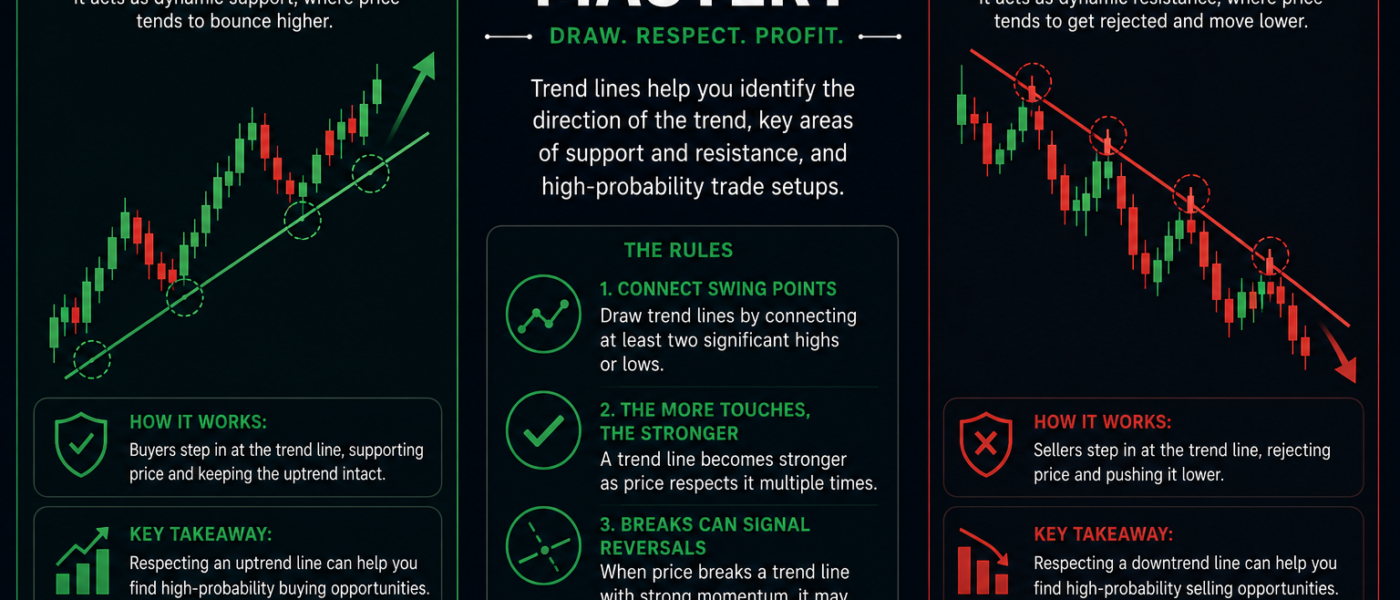
Trendline Mastery
How to Draw and Use Uptrends and Downtrends
Trendlines are one of the simplest yet most effective tools in technical analysis. They help traders identify the overall direction of the market and can provide valuable clues about possible future price movements.
Whether you trade stocks, forex, or cryptocurrency, understanding how to draw and use trendlines can improve your ability to spot trends, identify entry points, and manage risk more effectively.
In simple terms, trendlines are lines drawn on a chart to connect important price points. They visually show whether the market is moving upward, downward, or sideways.
What Is a Trend?
Before learning trendlines, it is important to understand what a trend actually is.
A trend is the general direction that price moves over time.
There are three main types of trends:
- Uptrend – Price is making higher highs and higher lows.
- Downtrend – Price is making lower highs and lower lows.
- Sideways trend – Price moves within a range without a clear direction.
Trendlines help traders recognise these patterns more easily.
What Is an Uptrend Line?
An uptrend line is drawn beneath price during an upward trend.
To draw an uptrend line:
- Find at least two higher low points on the chart.
- Draw a line connecting those lows.
- Extend the line into the future.
The line acts as dynamic support, meaning price may bounce from it multiple times as the trend continues.
For example:
- Bitcoin rises from £40,000 to £45,000
- Pulls back to £42,000
- Rises again to £48,000
- Pulls back to £44,000
Connecting the higher lows creates an uptrend line.
As long as price stays above the line, buyers are generally considered to be in control.
What Is a Downtrend Line?
A downtrend line is drawn above price during a downward trend.
To draw a downtrend line:
- Identify at least two lower highs.
- Draw a line connecting those highs.
- Extend the line forward.
The line acts as dynamic resistance, where price may repeatedly reject before moving lower again.
For example:
- Ethereum falls from £3,000 to £2,700
- Bounces to £2,850
- Falls again to £2,500
- Bounces to £2,700
Connecting the lower highs forms a downtrend line.
As long as price remains below the line, sellers are usually considered to have control.
Why Trendlines Matter
Trendlines are popular because they help traders:
- Identify the current market direction
- Find possible entry and exit points
- Spot trend reversals
- Detect breakout opportunities
- Improve risk management
Many traders use trendlines because they provide a simple visual guide to market structure. They can also help remove emotional decision-making by giving traders a clear framework to follow.
How Many Touches Make a Valid Trendline?
A trendline usually becomes more reliable when price touches it multiple times without breaking.
- Two touches create a possible trendline
- Three or more touches strengthen its importance
The more times price respects a trendline, the more traders may pay attention to it. No trendline lasts forever. Eventually trends weaken, reverse, or break entirely.
Trendline Breakouts
One of the most important signals in technical analysis occurs when price breaks a trendline.
Breaking an Uptrend Line
If price falls below an uptrend line, it may signal:
- Weakening buyer momentum
- A possible reversal downward
- Trend exhaustion
Breaking a Downtrend Line
If price rises above a downtrend line, it may suggest:
- Sellers losing control
- Potential bullish reversal
- Increasing buying pressure
Many traders wait for confirmation before acting on a breakout because false breakouts are common.
Common Trendline Mistakes
Beginner traders often make mistakes when drawing trendlines.
Forcing the Line
A trendline should fit naturally with the chart. Avoid adjusting lines unnaturally just to make them fit your idea.
Ignoring Wick Rejections
Some traders use candle bodies, while others include wicks. Both methods can work, but consistency is important.
Trading Every Breakout
Not every trendline break leads to a strong move. Markets can briefly break a line before reversing back.
This is why traders often combine trendlines with:
- Volume analysis
- Support and resistance
- RSI indicators
- Candlestick patterns
Dynamic Support and Resistance
Unlike horizontal support and resistance levels, trendlines move over time. This is why they are called dynamic support and resistance.
For example:
- An uptrend line rises gradually with price
- A downtrend line falls gradually with price
Trendline mastery helps traders adapt to changing market conditions rather than focusing only on fixed price levels. Trendlines are one of the easiest technical analysis tools to learn, yet they remain extremely powerful when used correctly.
An uptrend line helps traders identify rising markets and potential support zones, while a downtrend line highlights falling markets and possible resistance areas. Although trendlines are not perfect predictors of future price movement, they help traders understand market structure, momentum and possible reversals.
With practice, drawing trendlines becomes more natural, and you will begin recognising trends and breakout opportunities much faster across different markets and timeframe
