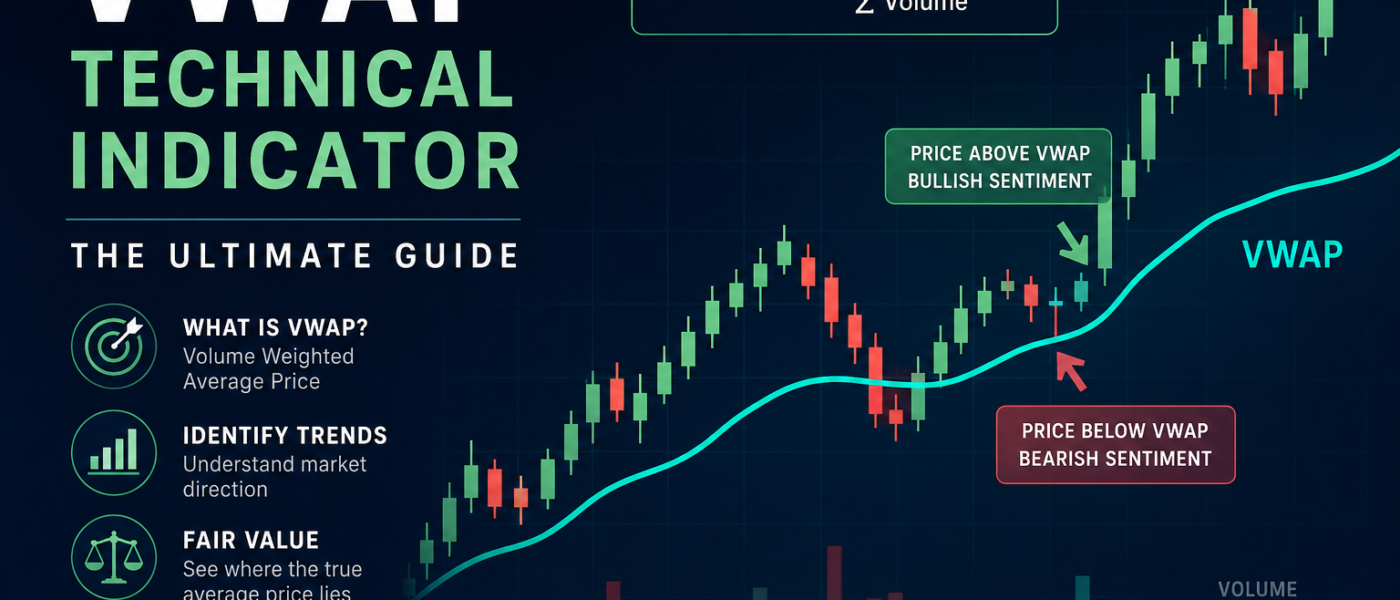
Understanding VWAP
The Volume Weighted Average Price, more commonly known as VWAP, is one of the most widely used technical indicators among professional traders, institutions, and active day traders. Unlike simple moving averages that only track price movement, it combines both price and trading volume to give traders a clearer picture of an asset’s true average value throughout the trading session.
VWAP is particularly popular in stock trading, futures, and cryptocurrency markets because it helps traders identify trend direction, fair value, and potential entry or exit points. Whether you are a beginner learning chart analysis or an experienced trader refining your strategy, understanding and can greatly improve your market awareness.
What Is VWAP?
Volume Weighted Average Price. It measures the average price an asset has traded at during the day, weighted by volume.
In simple terms, Volume Weighted Average Price shows where most of the trading activity has taken place. Because volume is included in the calculation, prices with higher trading activity have more influence on the indicator than prices with lower activity.
The formula for Volume Weighted Average Price is VWAP = \frac{\sum (Price \times Volume)}{\sum Volume} The calculation is reset at the beginning of each trading day and continuously updates as new price and volume data become available.
Traders Use Volume Weighted Average Price
VWAP is considered important because it reflects the average price institutions and large traders are paying throughout the session. Many professional trading desks use VWAP as a benchmark to measure execution quality.
For example:
- Buying below may indicate a trader is getting a better-than-average price.
- Selling above may indicate a stronger selling price than the market average.
Retail traders also use VWAP because it can help identify:
- Trend direction
- Support and resistance levels
- Momentum shifts
- Market sentiment
- Potential breakout opportunities
Unlike lagging indicators that can react slowly, VWAP often gives traders a real-time view of price efficiency during the session.
How VWAP Appears on a Chart
On most trading platforms, VWAP appears as a single line running through the price chart. The line dynamically changes throughout the trading session based on both price and volume activity.
When price trades above it generally suggests bullish market sentiment. Buyers are willing to pay prices above the average value of the session, which often indicates strength. When price trades below VWAP, it usually suggests bearish sentiment. Sellers are dominating the session, and price remains weaker than the average trading value.
Many traders also add VWAP bands to their charts, similar to Bollinger Bands. These bands can help identify overbought or oversold conditions.
Using VWAP for Trend Identification
One of the most common ways to use VWAP is for identifying trends.
Bullish Conditions
A market is often considered bullish when:
- Price remains above VWAP
- VWAP slopes upward
- Pullbacks bounce near the VWAP line
In strong uptrends, VWAP can act as dynamic support. Traders may look for buying opportunities when price retraces back toward the indicator before continuing higher.
Bearish Conditions
A market is often considered bearish when:
- Price remains below VWAP
- VWAP slopes downward
- Rallies fail near VWAP
In downtrends, VWAP can act as dynamic resistance, where traders may look for short-selling opportunities.
Volume Weighted Average Price Crossovers
Another popular strategy involves VWAP crossovers. When price crosses above VWAP, some traders view this as a bullish signal, especially if accompanied by increasing volume. This may suggest momentum is shifting upward.
When price crosses below VWAP, traders may interpret it as a bearish signal, indicating weakness or selling pressure. Like all indicators, VWAP should not be used in isolation. False signals can occur during choppy or sideways markets.
VWAP and Institutional Trading
Institutional traders frequently use VWAP to execute large orders without heavily impacting the market.
If a fund wants to buy a large number of shares, traders may attempt to purchase below VWAP to achieve a better average entry price. Because institutions manage massive positions, VWAP becomes an important benchmark for performance evaluation.
This institutional focus is one reason why VWAP can become a self-fulfilling indicator. Since so many professional traders monitor it, price often reacts around VWAP levels.
VWAP vs Moving Averages
VWAP is often compared to moving averages such as the 50-day or 200-day moving average. While they may look similar on charts, they function differently. A moving average only considers price over a set period.
VWAP considers both price and volume during the trading session. This difference makes VWAP more responsive to areas where heavy trading activity occurs. Many traders believe this gives VWAP an advantage for short-term intraday trading. Although moving averages are often more useful for longer-term trend analysis because VWAP resets each day.
The Limitations of VWAP
Best for Intraday Trading
VWAP is primarily designed for intraday analysis because it resets daily. Swing traders and long-term investors may find moving averages more useful for broader market trends.
Lagging Nature
Since VWAP is based on historical price and volume data, it is still considered a lagging indicator. It reacts to market movement rather than predicting future prices.
Less Effective in Sideways Markets
During low-volume or range-bound conditions, price may repeatedly cross above and below VWAP, creating misleading signals.
Because of this, many traders combine VWAP with other indicators such as RSI, MACD, or support and resistance analysis.
Tips for Trading With Volume Weighted Average Price
Here are a few practical tips when using VWAP:
- Use VWAP alongside volume confirmation
- Watch how price reacts during pullbacks
- Combined with candlestick patterns
- Avoid relying solely on crossovers
- Focus on higher-volume trading sessions
- Use proper risk management and stop-loss placement
Many traders also monitor the opening price in relation to VWAP, as this can reveal early market sentiment for the day. Volume Weighted Average Price is one of the most respected technical indicators in financial markets because it combines price action with trading volume. By showing the average traded price throughout the session and helps traders identify trend direction, market strength, and fair value.
Volume Weighted Average Price can serve as a valuable guide for entries, exits, and overall market bias. Institutions rely on it for trade execution, while retail traders use it to better understand price behaviour and momentum.
Although VWAP is not perfect and should not be used alone, it becomes much more effective when combined with solid risk management and additional technical analysis tools. Learning how to read and interpret it can provide traders with a deeper understanding of how markets move during the trading day.
