RSI Divergence
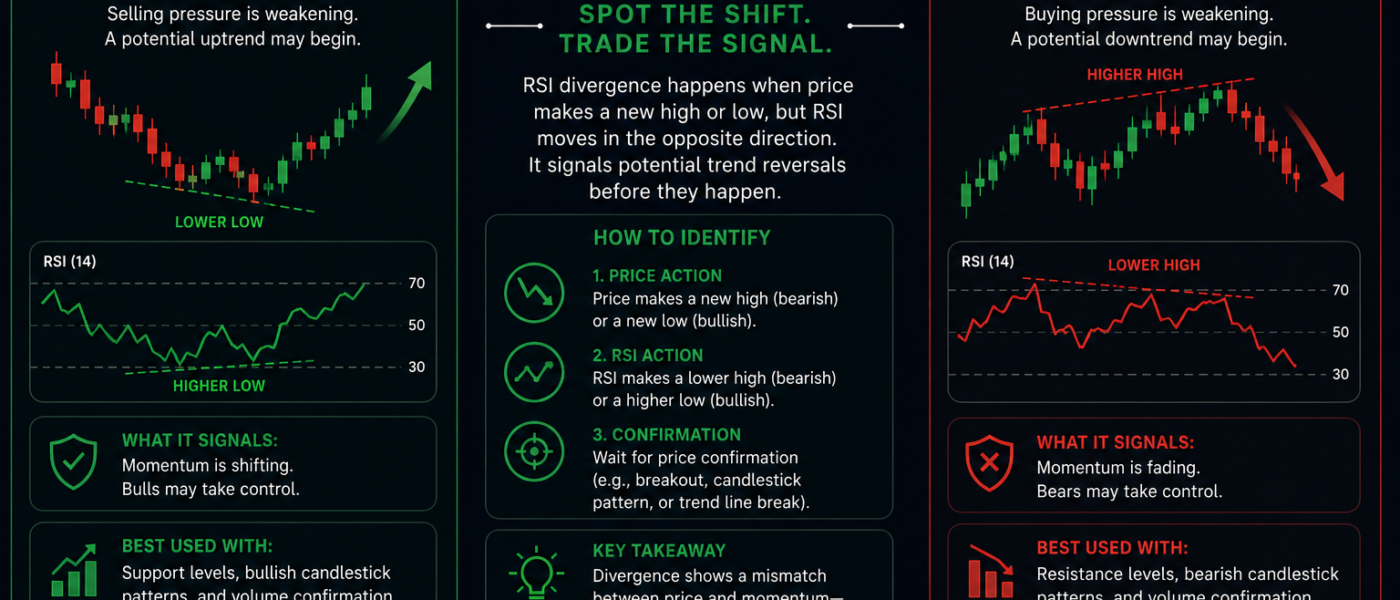
One of the most important but often misunderstood signals in technical analysis is RSI divergence , or when price continues to make higher highs while RSI fails to confirm it. This is known as bearish divergence, and it can be a powerful early warning that an uptrend is losing strength.
Unlike obvious reversal signals, the RSI divergence pattern is “hidden” because price still looks bullish on the surface. However, momentum beneath the move is quietly weakening.
What Is Happening on the Chart?
This setup occurs when:
- Price forms a Higher High (HH) → the market pushes to a new peak
- RSI forms a Lower High (LH) → momentum does not match the price move
So while price appears strong, RSI reveals that buying pressure is fading. This mismatch is what makes it important.
Why This Is Called a “Hidden Weakness” Signal
At first glance, everything looks normal:
- The trend is still rising
- Buyers are still pushing price higher
- New highs are being made
But RSI tells a different story:
- Each new push is weaker than the previous one
- Momentum is not confirming the price move
- The market is losing internal strength
This is why traders often call it a hidden signal — because it is not visible just by looking at price alone.
A Simple Way to Understand RSI Divergence
Think of price and RSI like this:
- Price = speed of the car
- RSI = engine strength
At the start of a trend:
- Strong engine (RSI rising)
- Strong acceleration (price rising)
Later in the trend:
- Car goes faster (price makes new highs)
- But engine struggles (RSI fails to match highs)
Eventually:
- The car cannot maintain speed
- The trend slows or reverses
What Bearish Divergence Usually Leads To
When this pattern appears, the market often reacts in one of three ways:
1. Pullback
Price temporarily drops to cool off overbought conditions.
2. Full Reversal
The uptrend ends and a new downtrend begins.
3. Sideways Consolidation
Momentum fades and price moves into a range. The outcome depends heavily on broader market conditions and confirmation signals.
Why This Pattern Happens and The Market Psychology
Bearish divergence reflects buyer exhaustion.
Here’s what is happening behind the scenes:
- Buyers push price to a new high
- Fewer new buyers enter at higher prices
- Each push requires more effort
- Sellers slowly begin to step in
- Momentum peaks before price does
So while price continues upward, the strength behind each move is weakening.
Example of Bearish Divergence
A simple illustration:
- Price High 1: £100
- RSI High 1: 70
- Price High 2: £105 (new higher high)
- RSI High 2: 62 (lower high)
Even though price is rising, RSI shows reduced strength. This is the key warning.
Why Traders Care About This Signal
Bearish divergence is important because it can:
- Warn of a potential reversal early
- Help avoid late entries into weakening trends
- Signal profit-taking opportunities
- Identify exhaustion near market tops
It is often seen near resistance zones or after extended rallies.
Where It Becomes Most Powerful
This signal is strongest when it aligns with:
- Resistance levels
- Trendline resistance
- Overbought RSI conditions (above 70)
- Bearish candlestick patterns (like Shooting Stars or Evening Stars)
- Declining volume on new highs
When multiple signals align, the probability of reversal increases.
Common Mistakes Traders Make
1. Treating it as an immediate sell signal
Divergence is a warning, not a trigger. Price can continue higher after it appears.
2. Ignoring trend strength
In very strong uptrends, divergence can appear early and persist for a long time.
3. Not waiting for confirmation
Many traders wait for:
- A break of support
- A bearish candle close
- A loss of structure (lower low formation)
How to Use It Properly
A practical approach is:
- Identify higher high in price
- Confirm RSI is making lower highs
- Mark key resistance or structure zones
- Wait for confirmation (break or rejection)
- Enter only when price confirms weakness
This reduces false signals and improves timing.
When price continues making higher highs but RSI makes lower highs, the market is sending an important message: momentum is fading beneath the surface.
While price is still climbing, the strength behind the move is weakening — often signalling that the trend is approaching exhaustion. On its own, this divergence is not a guaranteed reversal signal. But when combined with structure, volume, and candlestick confirmation, it becomes a powerful early warning tool for spotting potential market tops before the crowd react
