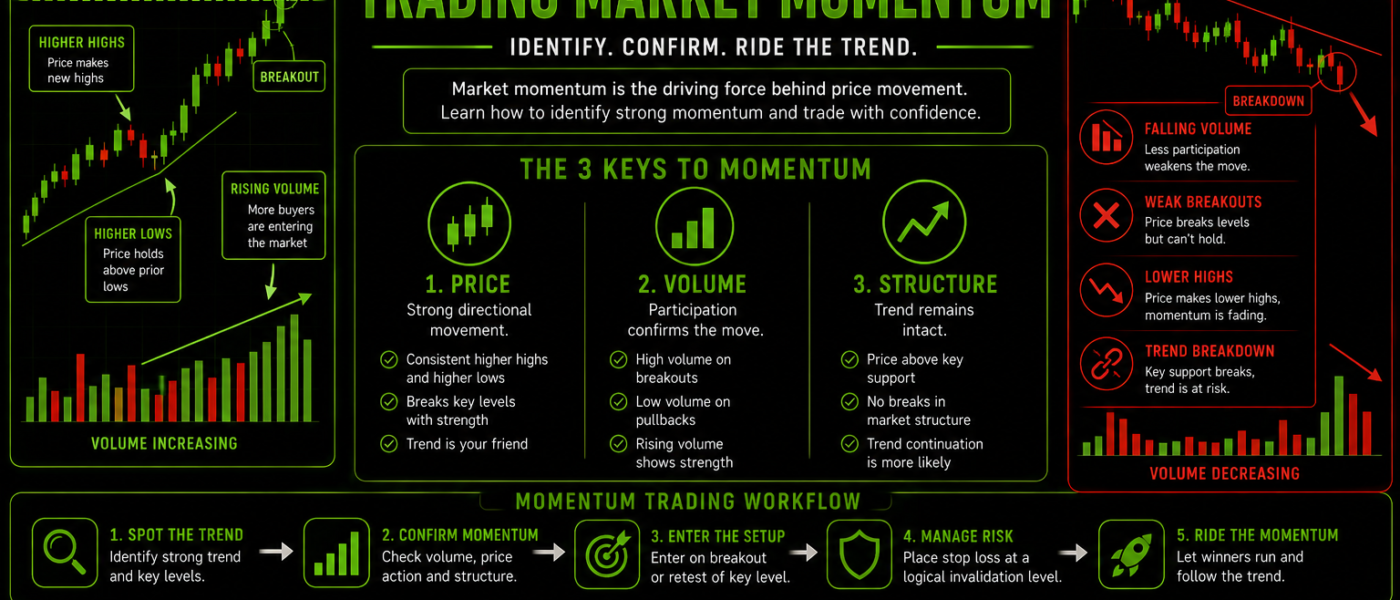
Beginners Guide to Trading Market Momentum
Breakout Trading Strategy
One of the most popular trading strategies used by traders around the world is the breakout trading strategy. Whether you’re trading stocks, forex, cryptocurrency, or commodities, breakouts can provide opportunities to enter strong market moves as they begin.
The idea behind breakout trading is simple: when price breaks through an important level of support or resistance, it often signals that buyers or sellers have gained control and momentum may continue in that direction. In this guide, we’ll explain what breakout trading is, how to identify potential breakout opportunities, and how beginners can avoid some of the common mistakes associated with this strategy.
What Is a Breakout?
A breakout occurs when price moves beyond a key support or resistance level that has previously contained market movement. Imagine a market that has been trading between £95 and £100 for several weeks. Buyers continue to step in near £95, while sellers repeatedly defend the £100 level. Eventually, one side wins the battle.
If buyers push the price above £100 and maintain control, a bullish breakout has occurred. If sellers force price below £95, a bearish breakout has occurred. Breakouts often attract attention because they can signal the beginning of a new trend or the continuation of an existing one.
Why Breakouts Happen
Markets move because of supply and demand. When a resistance level finally breaks, it often means buyers are willing to pay increasingly higher prices. At the same time, sellers who previously defended that level may begin closing positions. This combination can create strong upward momentum.
The opposite happens during bearish breakouts. Support levels fail because selling pressure overwhelms buying demand, causing price to move lower. Breakouts frequently occur around major news events, economic announcements, earnings reports, or periods of increased market participation.
Identifying Key Levels
Successful breakout trading begins with identifying important support and resistance levels. Look for areas where price has repeatedly reversed in the past. The more times a level has been tested, the more significant it becomes.
Common breakout areas include:
- Horizontal support and resistance levels
- Trend line breaks
- Chart patterns such as triangles
- Channel boundaries
- Previous swing highs and swing lows
Strong levels are often visible even when zooming out on the chart. Remember, the goal is not to predict the breakout. The goal is to prepare for one.
Confirming the Breakout
One of the biggest mistakes beginners make is entering a trade the moment price touches a key level.
Many apparent breakouts fail. These false breakouts, often called fakeouts, occur when price briefly moves beyond a level before quickly reversing. To improve your odds, traders often look for confirmation.
Some common confirmation signals include:
- A candle closing beyond support or resistance
- Increased trading volume
- Strong momentum candles
- A retest of the broken level
Waiting for confirmation may mean entering slightly later, but it can help filter out many low-quality setups.
Trading the Retest
Many experienced traders prefer trading the retest rather than the initial breakout.
After breaking resistance, price will often return to test that level before continuing higher. What was once resistance can become support.
Likewise, broken support often becomes resistance during a bearish retest.
Trading the retest offers several advantages:
- Better risk-to-reward ratios
- Clear stop loss placement
- Reduced chance of entering a false breakout
- More confidence in the trade setup
Patience is often rewarded when trading breakouts.
Where Should You Place Your Stop Loss?
Risk management is critical when using a breakout strategy. For bullish breakouts, traders often place stop losses below the breakout level or beneath the most recent swing low.
For bearish breakouts, stop losses are commonly placed above the breakout level or above the most recent swing high. Your stop loss should be placed at a point where your trade idea becomes invalid.
Avoid moving your stop loss further away after entering a trade. If the market proves your analysis wrong, accept the loss and move on.
Managing Your Trade
Once a breakout begins moving in your favour, it is important to manage the trade effectively. Some traders use a fixed risk-to-reward ratio, such as targeting twice the amount they risked.
Others trail their stop loss behind market structure, allowing them to capture larger trends when momentum remains strong. There is no single correct approach. The key is to remain consistent and follow a plan. Emotional decisions often lead to poor results.
Common Breakout Trading Mistakes
Many beginner traders encounter similar problems when trading breakouts.
The most common mistakes include:
Chasing the Move
Entering after a large breakout candle has already travelled a significant distance can expose traders to poor risk-to-reward opportunities.
Ignoring Volume
Low-volume breakouts are often less reliable than those supported by strong participation.
Trading Every Breakout
Not every breakout deserves a trade. Focus on high-quality setups around significant levels.
Poor Risk Management
Even the best breakout strategy will experience losing trades. Proper position sizing and stop loss placement are essential.
Breakout trading is one of the simplest and most effective strategies available to traders. By focusing on key support and resistance levels, waiting for confirmation, and managing risk carefully, traders can position themselves to take advantage of powerful market moves. The most important lesson is patience. Many beginners rush into trades before a breakout is confirmed, only to get caught in a fakeout.
Wait for the market to show its hand, manage your risk, and remember that successful trading is about consistency rather than catching every move. Master the basics of breakout trading, and you’ll have a valuable strategy that can be applied across virtually any financial market.
