Guide To Ichimoku Cloud
The Ichimoku Cloud is one of the most powerful and visually unique technical indicators used in financial markets today. Originally developed in Japan, the indicator helps traders identify trends, support and resistance levels, momentum, and potential entry or exit points all from a single chart setup.
Although it may look complicated at first glance, the Ichimoku Cloud becomes much easier to understand once each part is broken down individually. Many traders prefer it because it provides a complete overview of market conditions without needing several separate indicators.
In this guide to Ichimoko cloud
, we will explain what the Ichimoku Cloud is, how it works, and how traders use it to make trading decisions.
What Is the Ichimoku Cloud?
The Ichimoku Cloud, also known as “Ichimoku Kinko Hyo,” was created by Japanese journalist Goichi Hosoda in the late 1930s. The name roughly translates to “one glance equilibrium chart,” because the indicator is designed to allow traders to assess the market quickly at a glance.
Unlike simple indicators such as moving averages or RSI, the Ichimoku Cloud combines multiple calculations into one complete system. It creates a “cloud” on the chart that helps traders visualise trend direction and market strength.
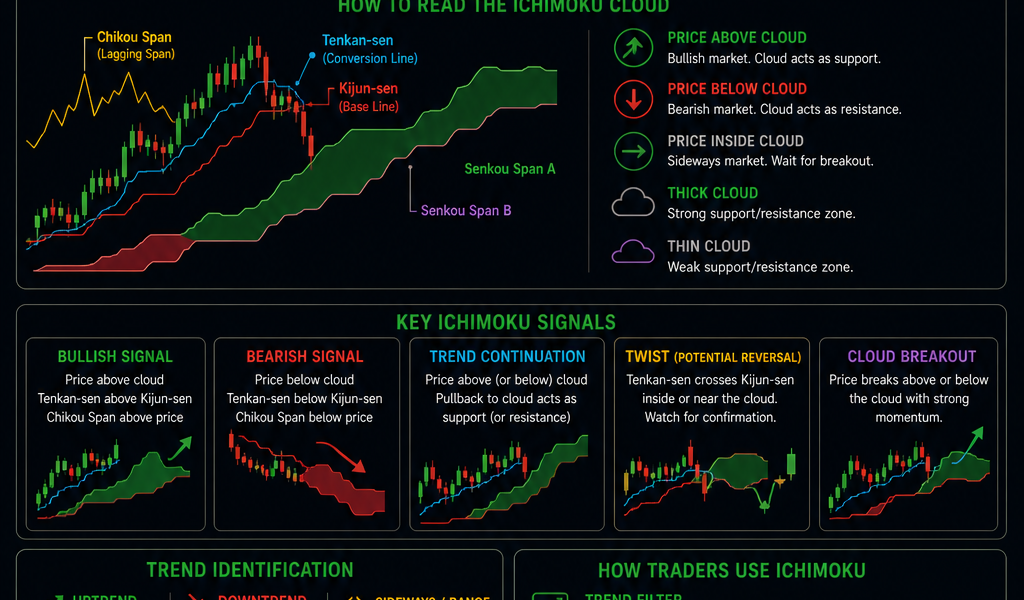
The indicator consists of five main lines:
- Tenkan-sen (Conversion Line)
- Kijun-sen (Base Line)
- Senkou Span A
- Senkou Span B
- Chikou Span (Lagging Line)
Together, these components form the famous cloud structure.
The Main Components of the Ichimoku Cloud
Tenkan-sen (Conversion Line)
The Tenkan-sen is a short-term trend indicator. It is calculated using the average of the highest high and lowest low over the previous nine periods.
Traders use this line to identify short-term momentum. When the Tenkan-sen moves upward sharply, it suggests strong bullish momentum. When it moves downward, bearish momentum may be developing.
Kijun-sen (Base Line)
The Kijun-sen measures medium-term trend direction. It is calculated using the highest high and lowest low over the previous 26 periods. This line is often viewed as a key support or resistance level. Many traders also use it as a trailing stop-loss guide during trends.
When price stays above the Kijun-sen, the market is generally considered bullish. When price falls below it, bearish conditions may be present.
Senkou Span A and Senkou Span B
These two lines create the actual “cloud,” also known as the Kumo.
- Senkou Span A is the average of the Tenkan-sen and Kijun-sen projected forward.
- Senkou Span B is based on the average of the highest high and lowest low over 52 periods, also projected forward.
The area between these two lines forms the cloud itself.
When Span A is above Span B, the cloud is usually coloured green and signals bullish conditions. When Span B is above Span A, the cloud often turns red or bearish.
Chikou Span (Lagging Line)
The Chikou Span is today’s closing price shifted backward by 26 periods.
This line helps confirm trend direction and momentum. If the Chikou Span is above past prices, bullish momentum may be strong. If it is below past prices, bearish momentum may dominate.
Understanding the Cloud
The cloud is the most important part of the Ichimoku system because it acts as dynamic support and resistance.
Here is the basic interpretation:
- Price above the cloud = bullish trend
- Price below the cloud = bearish trend
- Price inside the cloud = sideways or uncertain market
The thickness of the cloud also matters. A thick cloud often signals stronger support or resistance, while a thin cloud may be easier for price to break through. One reason traders like the Ichimoku Cloud is because it projects future support and resistance levels ahead of current price action.
How Traders Use the Guide To Ichimoku Cloud
Trend Identification
The simplest use of the Ichimoku Cloud is trend detection.
If price remains above the cloud and the cloud is green, traders often look for buying opportunities. If price stays below the cloud and the cloud is red, traders may focus on short-selling opportunities.
This helps traders avoid trading against the dominant market trend.
Crossovers
One of the most common Ichimoku trading signals occurs when the Tenkan-sen crosses the Kijun-sen.
A bullish crossover happens when the Tenkan-sen crosses above the Kijun-sen. This may signal upward momentum. A bearish crossover happens when the Tenkan-sen crosses below the Kijun-sen. This may signal downward momentum.
Signals become stronger when they occur above or below the cloud rather than inside it.
Support and Resistance
The cloud itself acts like a moving support and resistance zone.
In an uptrend, traders often expect price pullbacks to bounce from the cloud before continuing higher. In a downtrend, the cloud may act as resistance that prevents price from rising further.
Advantages of the Ichimok9 Cloud
The Ichimoku Cloud has several strengths that make it popular among traders:
- Combines multiple indicators into one system
- Helps identify trends quickly
- Shows momentum and support/resistance simultaneously
- Works well in trending markets
- Can be used on different timeframes
Because it provides so much information at once, many traders use it as a complete standalone trading system.
Limitations of the Ichimoku Cloud
Despite its advantages, the indicator is not perfect. The main weakness of the Ichimoku Cloud is that it can become confusing for beginners because of the number of lines displayed on the chart.
It may also produce false signals during sideways or choppy market conditions where price repeatedly moves in and out of the cloud. Like all technical indicators, it works best when combined with proper risk management and confirmation from price action or volume analysis.
The Ichimoku Cloud is one of the most advanced and versatile technical indicators available to traders. Although it appears complex initially, understanding the role of each component makes the system much easier to use.
By helping traders identify trends, momentum, support, and resistance all in one place, the Beginners Guide To Ichimoki Cloud remains a favourite tool among forex, crypto, stock, and commodity traders worldwide. The best approach is to start simple by focusing first on the relationship between price and the cloud itself. Once comfortable, traders can gradually incorporate crossover signals and cloud analysis into a complete trading strategy.
