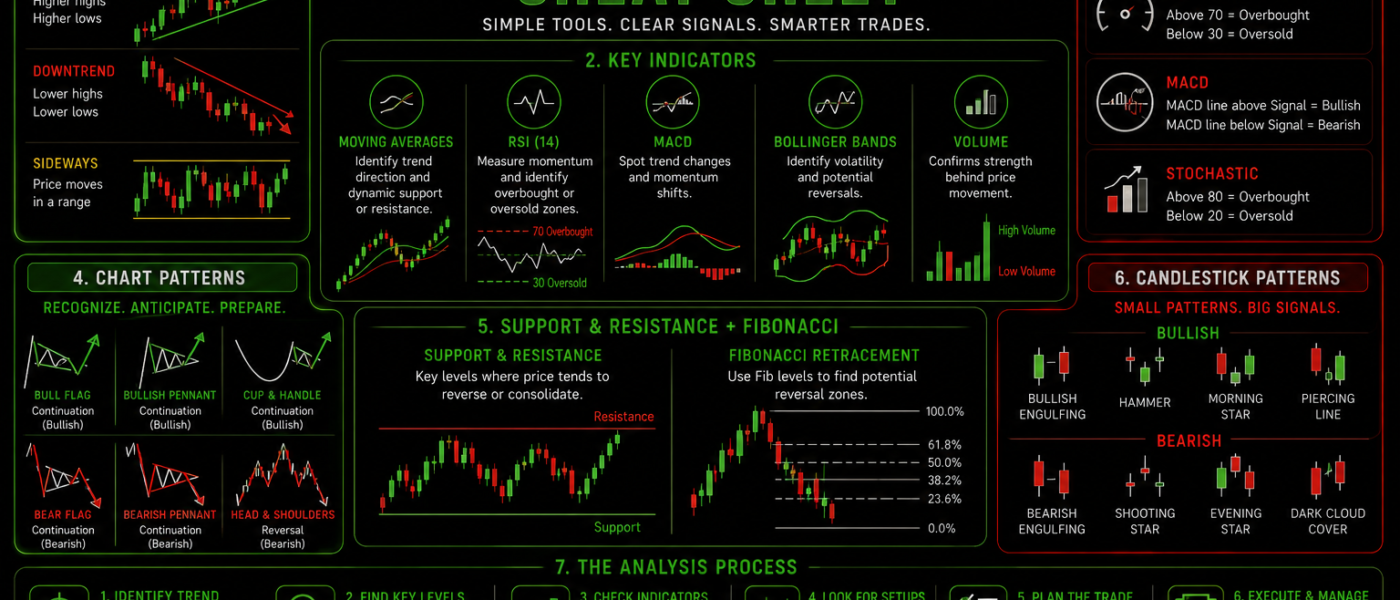
Beginners Technical Analysis Cheat Sheet:
Foundational Chart Reading
1. Introduction to Technical Analysis (TA)
Technical Analysis (TA) is the discipline of analysing historical market data—primarily price and volume—to forecast future price movements. While Fundamental Analysis focuses on a company’s financial health and intrinsic value for long-term investing, TA provides a lens into market psychology to help traders time entries and exits. TA is applicable across all liquid markets, including stocks, forex, gold, and cryptocurrencies.
The Core Rule:
Technical analysis doesn’t deal with absolutes; it deals with probabilities. No indicator or pattern is a guarantee. In extreme “Black Swan” events or periods of severe market imbalance, traditional TA can become less reliable as mass emotion overrides historical patterns. Success relies on identifying high-probability setups and managing risk when the market defies expectation.
2. The Three Pillars of Price Visualisation
Traders use different chart types to visualize the battle between supply and demand over specific time intervals (e.g., 5 minutes, 1 day, or 1 year).
Chart Type | Structure | Primary Utility |
|---|---|---|
Line Chart | A single line connecting the closing prices for a specific interval. | Ideal for a clean, simplified assessment of long-term trends and closing price comparisons. |
Bar Chart | Vertical bars showing the High, Low, Open, and Close (OHLC). | Visualises volatility; the vertical height reflects the price range, while horizontal tabs show open (left) and close (right). |
Candlestick | Visualizes sentiment using “bodies” and “wicks/shadows.” | Displays bullish (green) or bearish (red) conviction at a glance; combinations form patterns used for trade signals. |
The Five Data Points of a Candlestick
Every individual candlestick provides five essential data points:
- Open: The starting price for the period.
- Close: The final price for the period.
- Low of Day (LOD): The absolute lowest price reached.
- High of Day (HOD): The absolute highest price reached.
- Direction: Indicated by colour (Green = bullish/up; Red = bearish/down).
3. The Psychology of Support and Resistance
- Support: A psychological “floor” where buying interest historically takes control, preventing price from falling further.
- Resistance: A psychological “ceiling” where selling pressure historically stops a rally and causes a reversal.
Psychological Role Reversal (The Flip)
When a level is definitively broken, its function often flips:
- Broken Resistance frequently becomes future Support.
- Broken Support frequently becomes future Resistance.
Pro Tip: A level is “strengthened” if the price tests it on low volume and fails to break it. However, a successful breakout usually requires high volume to prove the market has the conviction to penetrate that psychological barrier.
4. Primary Technical Indicators: Function and Signals
Indicators filter market noise to confirm price action. They should be used to build a case, not as standalone “buy/sell” buttons.
Moving Averages (MA)
Moving Averages smooth out price action to identify the overall trend bias.
- Long-Term Trends: The 50 MA and 200 MA are the industry standards. A “Golden Cross” (50 crossing above 200) suggests long-term bullishness, while a “Death Cross” (50 crossing below 200) suggests a bearish regime.
- Short-Term Trends: The 5 MA and 20 MA provide dynamic support and resistance levels for faster-moving trades.
Relative Strength Index (RSI)
A momentum oscillator ranging from 0 to 100 used to identify if an asset is overextended.
- Critical Thresholds: Traditionally, >70 is “Overbought” (market topping) and <30 is “Oversold” (bounce likely).
- The RSI Warning: An RSI below 30 is not an immediate buy signal. In “Black Swan” events, RSI can drop to single digits and stay oversold for long periods while the price continues to crash.
- RSI Divergence: Occurs when price makes a new low but RSI makes a higher low (bullish), or price makes a higher high but RSI makes a lower high (bearish).
MACD (Moving Average Convergence Divergence)
A trend-following momentum indicator consisting of four components:
- MACD Line: The “fast” line reacting quickly to price changes.
- Signal Line: The “slow” line acting as the trigger.
- Histogram: The bars representing the difference between the MACD and Signal lines; the bars grow larger as momentum strengthens.
- Zero Line: The centre point; being above this line generally indicates a bullish bias.
- Signals: The histogram turns green when the MACD line is above the Signal line (upward momentum) and red when it is below (downward momentum).
5. Essential Chart Patterns for Trend Reversals and Breakouts
Patterns visualise the transition of power between buyers and sellers.
- Head and Shoulders (and Inverse): A reversal pattern featuring three peaks; the “Head” is the highest, flanked by two “Shoulders.” Actionable Clue: Enter when the price breaks the “Neckline” support on a spike in volume.
- Double Top (M-shape) and Double Bottom (W-shape): Reversal patterns where the price fails twice to break a specific resistance or support level. Actionable Clue: A Double Top is confirmed when the price breaks below the “interim low” following the second rejection at resistance.
- Triangles (Ascending and Descending): Bilateral patterns where price moves into increasingly narrow ranges. Actionable Clue: Enter in the direction of the breakout once price closes outside the converging trendlines.
6. Volume Analysis: The Key to Confirmation
Volume is the total number of shares or contracts traded. It is the “lie detector” of technical analysis.
- The Confirmation Rule: High volume validates a move as having high conviction; low volume suggests a “fakeout” or fading interest. For example, a Bullish Engulfing candle on high volume is a much stronger reversal signal than one on low volume.
Stock Volume vs. Forex Volume
- Stock/Crypto Volume: Generally more transparent; stocks use centralised exchanges (NYSE), and many crypto exchanges provide public ledgers.
- Forex Volume: Decentralised and “broker-dependent.” It reflects the activity of a specific broker’s clients rather than the entire global market, making it less absolute but still useful for sentiment.
7. The Beginner’s Risk Management Checklist
The first goal of a trader is not to win, but to avoid losing your capital.
- Cut Your Losses: Always identify your “invalidation point” before entering. Set a stop-loss to accept being wrong without destroying your portfolio.
- Avoid Overtrading: Jesse Livermore famously noted, “Money is made by sitting, not trading.” Wait for high-probability signals rather than trading out of boredom.
- Manage Emotions: Avoid “Revenge Trading” to win back losses. If you lose your analytical objectivity, step away from the screen.
- Use Confluence: Never trade an indicator in isolation. Seek 3 to 5 confirming signals (e.g., a Double Bottom at a support level with an RSI crossover and high volume) before committing capital.
