Where Should You Place Your Stop Loss?
One of the biggest mistakes beginner traders make is focusing only on where to enter a trade. While finding a good entry is important, knowing where to place your stop loss is what protects your trading account and keeps you in the game long enough to become consistently profitable.
A stop loss is an order that automatically closes your trade when the market reaches a predetermined price. Its purpose is simple: limit your losses if the market moves against you. Every successful trader uses stop losses because no trading strategy wins 100% of the time.
The question isn’t whether you should use a stop loss. The real question is where should you place it?
Why Stop Loss Placement Matters
Many beginners place their stop loss at a random distance from their entry. Others use fixed percentages such as 2% or 5% regardless of market conditions. This approach often leads to unnecessary losses because the stop is not based on the actual structure of the market.
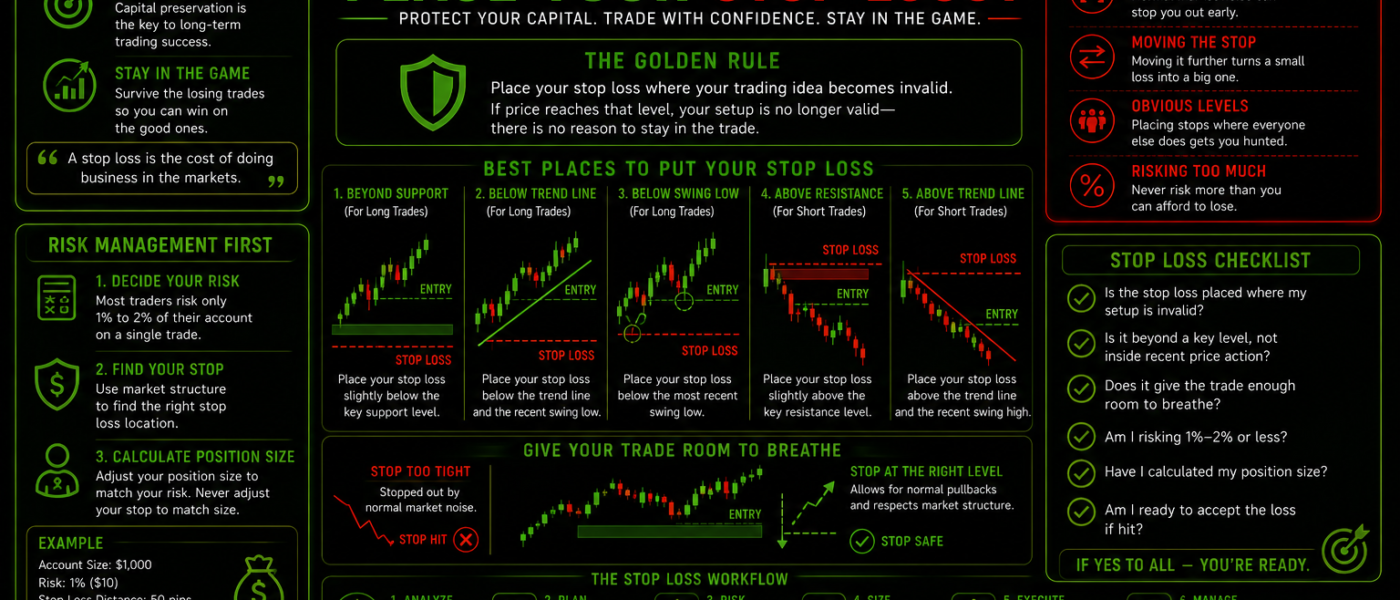
A good stop loss should be placed where your trading idea becomes invalid. If price reaches that level, the setup you identified is no longer working, and there is no reason to remain in the trade.
Think of your stop loss as the point where you admit the market is proving your analysis wrong.
Using Support and Resistance
One of the most effective ways to place a stop loss is beyond key support and resistance levels.
If you enter a long position near a support level, your stop loss should usually be placed slightly below that support. If price breaks below support, there is a good chance the market structure is changing and your trade idea may no longer be valid.
Likewise, if you enter a short position near resistance, placing your stop slightly above that resistance level makes sense. A breakout above resistance could signal that sellers are losing control.
The key word here is “slightly.” Placing a stop exactly on support or resistance often results in getting stopped out by normal market noise.
Stop Losses and Trend Lines
Trend lines can also help determine logical stop loss locations.
In an uptrend, traders often place stop losses below the trend line and beneath the most recent swing low. If the trend line breaks and price forms a lower low, the uptrend may be weakening.
In a downtrend, stop losses are commonly placed above the trend line and above the most recent swing high.
This method allows traders to stay in a trade while the trend remains intact and exit when the trend structure begins to fail.
Using Swing Highs and Swing Lows
Market structure is one of the most reliable tools for stop loss placement.
For long trades, a stop loss is often placed below the most recent swing low. For short trades, it is commonly placed above the most recent swing high.
The logic is simple. If price breaks beyond these important turning points, the market may be creating a new structure that no longer supports your original trade idea.
This approach works well because it uses actual price action rather than arbitrary numbers.
Avoid Tight Stop Losses
One of the most frustrating experiences for traders is watching their stop loss get hit, only to see the market move in their intended direction moments later.
This usually happens when stop losses are placed too close to the entry.
Markets naturally fluctuate. Small pullbacks and temporary spikes are normal. If your stop loss is too tight, you may be stopped out by ordinary price movement rather than a genuine failure of the trade setup.
Giving the market enough room to breathe is often just as important as protecting your capital.
Risk Management Comes First
Stop loss placement should always be linked to risk management.
Before entering any trade, decide how much of your account you are willing to risk. Many experienced traders risk only 1% to 2% of their trading capital on a single trade.
For example, if your account is worth £1,000 and you risk 1%, your maximum loss is £10. Once you know where your stop loss needs to be based on market structure, you can adjust your position size accordingly.
This is a crucial concept. Professional traders do not move their stop loss to fit their position size. They adjust their position size to fit the stop loss.
Common Stop Loss Mistakes
Several mistakes repeatedly catch beginner traders off guard.
The first is moving a stop loss further away after entering a trade. This often turns a small planned loss into a much larger one.
The second is trading without a stop loss altogether. While it may work occasionally, one large move against your position can wipe out weeks or even months of progress.
Another mistake is placing stops at obvious levels where many traders are likely to place theirs. Large market participants are aware of these levels, and price can sometimes briefly move through them before reversing.
A stop loss is more than just a safety net. It is an essential part of every trading strategy. The best stop loss locations are based on market structure, support and resistance, trend lines, and swing highs or lows—not random percentages or guesswork.
Remember, successful trading is not about avoiding losses altogether. Losses are a normal part of the process. The goal is to keep losses small while allowing winning trades the opportunity to grow.
Place your stop loss where your trading idea becomes invalid, manage your risk carefully, and stay disciplined. Over time, this simple habit can make a huge difference to your long-term trading success.
