Hammer And Inverted Hammer
Spotting Bullish Reversals at the Bottom
Candlestick patterns are one of the most useful tools in technical analysis, helping traders understand market sentiment and identify potential turning points. Among the most well-known bullish reversal patterns are the Hammer and the Inverted Hammer.
These patterns often appear after a price decline and can signal that sellers are losing control while buyers begin to step back into the market. Learning to recognise these candlestick formations can help traders spot possible market bottoms and prepare for potential upward reversals.
What Is a Hammer Candlestick?
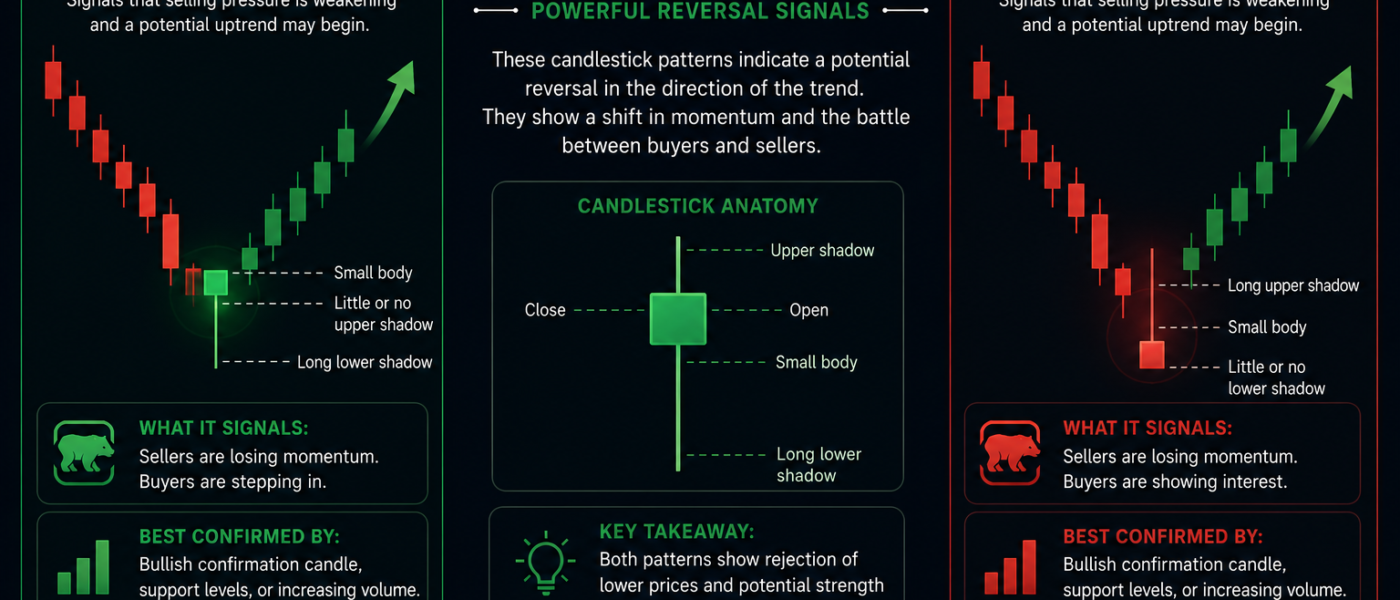
A Hammer is a single candlestick pattern that typically appears after a downtrend. It has a small candle body near the top of the price range and a long lower wick, with little or no upper wick.
The long lower wick shows that sellers pushed the price significantly lower during the trading period, but buyers stepped in and drove the price back up before the candle closed. This suggests that buying pressure is increasing and that the market may be preparing to reverse upward.
A Hammer usually looks like this:
- Small body near the top
- Long lower wick (often at least twice the size of the body)
- Very small or no upper wick
The colour of the candle can vary. A green Hammer is often considered slightly more bullish than a red one, but both can carry the same general meaning.
What Is an Inverted Hammer?
An Inverted Hammer also appears after a downtrend and can signal a possible bullish reversal. It has a small candle body near the bottom of the range and a long upper wick, with little or no lower wick.
This pattern shows that buyers attempted to push the price much higher during the session, although sellers brought the price back down before the close. While the price did not hold at the highs, the strong upward attempt suggests buyers may be gaining strength.
An Inverted Hammer usually has:
- Small body near the bottom
- Long upper wick
- Little or no lower wick
This pattern often requires confirmation from the next candle before traders trust the reversal signal.
Why These Patterns Matter
Both the Hammer and Inverted Hammer are important because they can signal that selling pressure is starting to weaken. At the end of a downtrend, many traders watch for signs that buyers are starting to regain control. These candlestick patterns can act as early clues that the market may soon move higher. However, these patterns do not guarantee a reversal. They simply suggest that market conditions may be changing.
The Psychology Behind the Hammer
Understanding market psychology makes these patterns easier to interpret.
In a Hammer:
- Sellers push the price sharply lower
- Buyers absorb the selling pressure
- Price closes near the opening price or higher
This shows that despite heavy selling, buyers were strong enough to recover most or all of the losses. That shift in control can signal the start of a bullish move.
The Psychology Behind the Inverted Hammer
In an Inverted Hammer:
- Buyers push the price sharply upward
- Sellers force the price back down
- The close remains near the lower part of the candle
Even though sellers regained some control, the strong buying attempt suggests demand may be returning. This can be an early warning that momentum is beginning to shift.
Confirmation Is Important
Traders rarely rely on a Hammer or Inverted Hammer alone.
Most wait for confirmation, such as:
- A bullish candle closing above the Hammer
- Increased trading volume
- Price bouncing from a support level
- Positive momentum from indicators like RSI
Confirmation helps reduce the risk of false signals.
For example:
- A Hammer forms at a major support level
- Volume increases
- The next candle closes higher
This combination may provide a stronger bullish setup.
Common Mistakes to Avoid
Trading the Pattern Without Context
A Hammer or Inverted Hammer is most meaningful after a downtrend. If it appears in the middle of a sideways market, it may not carry much significance.
Ignoring Volume
A reversal pattern supported by strong volume is often more reliable than one forming on low volume.
Entering Too Early
Many traders jump in as soon as they see the pattern. Waiting for confirmation can improve decision-making and reduce unnecessary losses.
Combining With Other Technical Tools
The Hammer and Inverted Hammer work best when combined with other forms of analysis, such as:
- Support and resistance
- Trendlines
- Volume analysis
- RSI indicators
- Moving averages
A Hammer appearing at a key support level with oversold RSI and rising volume may be considered a stronger bullish signal.
The Hammer and Inverted Hammer are valuable candlestick patterns that can help traders spot possible bullish reversals at the bottom of a downtrend. The Hammer shows buyers rejecting lower prices, while the Inverted Hammer suggests buyers are beginning to test higher prices.
Although neither The Hammer And Inverted Hammer patterns guarantee that price will rise, understanding how to identify different types of candle stick patterns ,and them and combine them with other technical tools can improve chart reading skills and trading confidence.
