Morning and Evening Stars:
The Candle Patterns for Major Trend Changes
Some candlestick patterns go beyond simple signals and instead show a clear shift in market sentiment. Among the most powerful of these are the Morning Star and Evening Star patterns. These are three-candle reversal patterns that often appear at major turning points in the market. Unlike single-candle signals, they show a more gradual transition between buyers and sellers, making them more reliable when used correctly.
What Is a Morning Star?
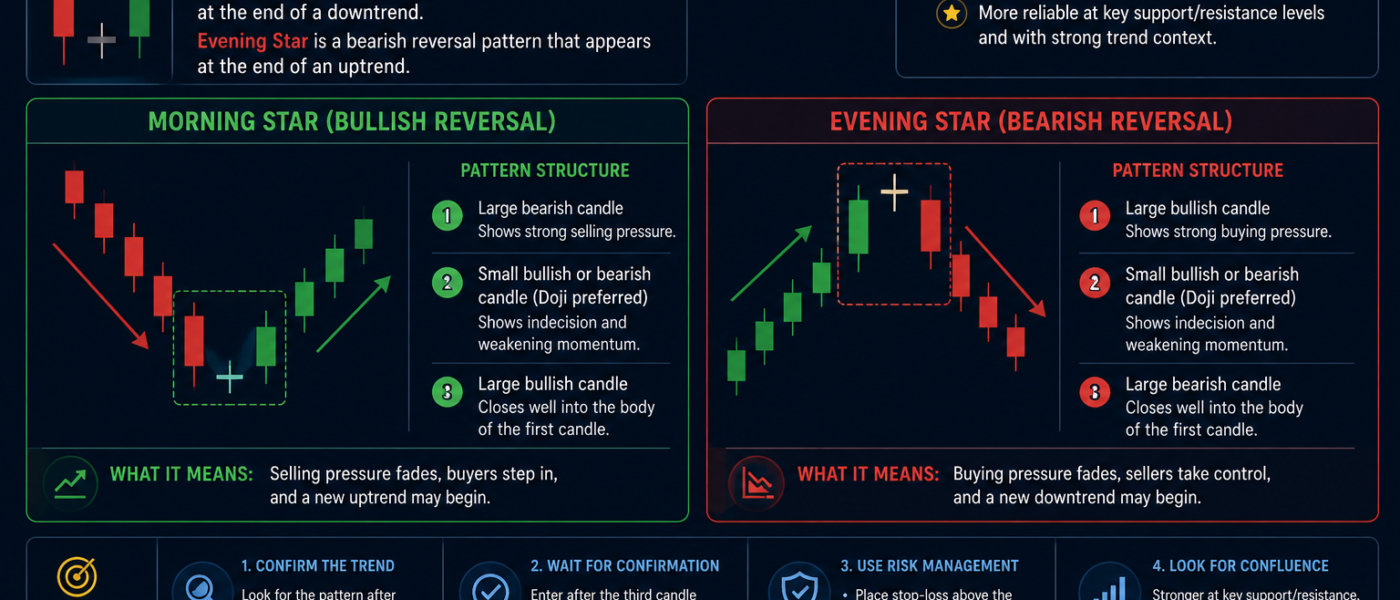
A Morning Star is a bullish reversal pattern that appears after a downtrend and signals that sellers may be losing control. It consists of three candles:
1. First Candle (Bearish Momentum)
- Strong red candle
- Confirms ongoing downtrend
- Sellers are in control
2. Second Candle (Indecision)
- Small body (can be red, green, or a Doji)
- Shows hesitation in the market
- Momentum is weakening
3. Third Candle (Bullish Reversal)
- Strong green candle
- Closes well into or above the first candle’s body
- Buyers take control
Together, this sequence suggests a potential trend reversal upward.
Morning Star Psychology
The Morning Star tells a story of shifting control:
- Sellers push price lower with confidence
- Market slows — buyers stop the decline
- Buyers step in aggressively
- Momentum shifts upward
It represents a transition from bearish dominance → indecision → bullish control. This is why Morning Stars are often seen near market bottoms.
What Is an Evening Star?
The Evening Star is the opposite of the Morning Star and appears after an uptrend, signalling a potential bearish reversal.
It also consists of three candles:
1. First Candle (Bullish Momentum)
- Strong green candle
- Confirms ongoing uptrend
- Buyers are in control
2. Second Candle (Indecision)
- Small body or Doji
- Market hesitates
- Momentum begins to stall
3. Third Candle (Bearish Reversal)
- Strong red candle
- Closes deep into or below the first candle’s body
- Sellers take control
This sequence suggests a possible trend reversal downward.
Evening Star Psychology
The Evening Star reflects a gradual shift in control:
- Buyers push price higher with strength
- Momentum slows — market becomes uncertain
- Sellers step in aggressively
- Downward momentum begins
It often appears near market tops or resistance zones.
Why Three-Candle Patterns Are Stronger
Compared to single-candle patterns like Dojis or Hammers, Morning and Evening Stars are more reliable because they show:
- A full momentum cycle
- A transition phase (indecision)
- A confirmation candle
This makes them more structured and easier to trust in strong trending markets.
Importance of the Middle Candle (The “Star”)
The middle candle is what gives these patterns their name. It represents market indecision, where neither buyers nor sellers are fully in control.
Key points:
- Small body = hesitation
- Can gap away from previous candle (stronger signal)
- Often reflects exhaustion of the prior trend
The further it separates from the first candle, the stronger the pattern can be.
Confirmation Is Critical
Even though these are strong reversal patterns, traders still wait for confirmation.
Bullish Confirmation (Morning Star):
- Next candle closes higher
- Break above resistance or trendline
- Increasing volume
Bearish Confirmation (Evening Star):
- Next candle closes lower
- Breakdown of support
- Rising selling volume
Without confirmation, the pattern can fail or turn into a false signal. Where The Morning and Evening Stars Patterns Are Most Effective Morning and Evening Stars work best when they appear at key market levels:
- Support zones (Morning Star)
- Resistance zones (Evening Star)
- Trendline bounces or breaks
- Overbought/oversold conditions
- After extended trends
They are most powerful when they align with broader market structure.
Common Mistakes Traders Make
1. Ignoring Trend Context
These patterns only matter after a clear trend. In sideways markets, they lose reliability.
2. Entering Too Early
Jumping in before the third candle confirms direction can lead to false signals.
3. Overlooking Volume
Low volume reduces the strength of the reversal signal.
4. Forcing the Pattern
Not every three-candle formation is a true Morning or Evening Star — structure must be clear.
Combining With Other Indicators
These patterns become even more powerful when combined with:
- Support & Resistance levels
- Trendlines
- RSI divergence
- Volume spikes
- Moving averages
Example:
- Price hits resistance
- Evening Star forms
- RSI shows overbought conditions
- Volume increases on third candle
→ stronger bearish reversal setup
Morning and Evening Stars are among the most reliable three-candle reversal patterns in technical analysis. They show a clear transition between buyers and sellers, making them useful for spotting potential major trend changes. The Morning Star signals that selling pressure is fading and buyers are taking control, while the Evening Star suggests that buying pressure is weakening and sellers are stepping in. Although not perfect on their own, these patterns become powerful when combined with confirmation signals and key market levels.
With practice, they can help traders identify turning points earlier and better understand when momentum is truly shifting in the market.
