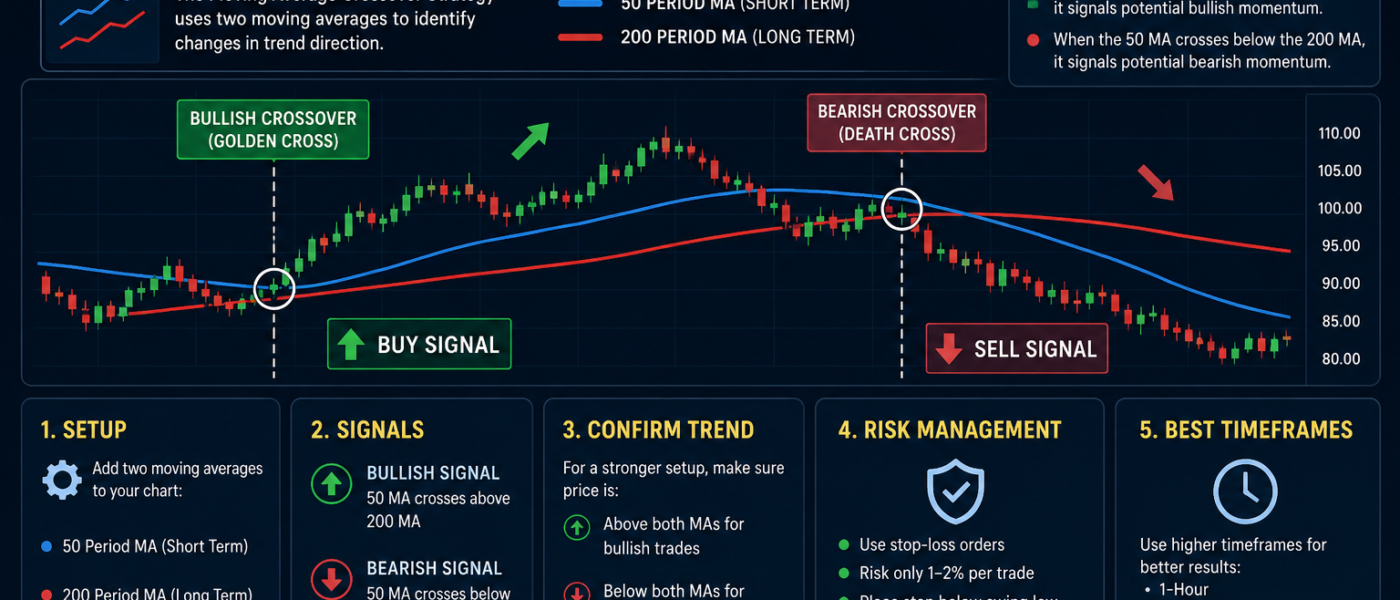
Moving Average Strategy Guide
A Beginner-Friendly Trading Method
For beginners entering the world of technical analysis, one of the biggest challenges is finding a trading strategy that is simple, structured, and easy to follow. Many new traders become overwhelmed by complicated indicators, confusing chart patterns, and fast-moving price action. Fortunately, some of the most effective strategies are also the easiest to understand.
One of the most popular beginner trading methods is the Moving Average Crossover Strategy. This strategy has been used by traders for decades because it helps identify trends clearly while removing much of the emotional decision-making that causes beginners to lose money.
In this article, you will learn what moving averages are, how crossover signals work, how traders enter and exit positions, and the advantages and disadvantages of this beginner-friendly strategy.
What Is a Moving Average?
A moving average is a technical indicator that smooths out price movement over a certain period of time. Instead of focusing on every small price fluctuation, moving averages help traders identify the overall direction of the market.
The two most common types are:
- Simple Moving Average (SMA)
- Exponential Moving Average (EMA)
The SMA calculates the average price over a selected number of periods, while the EMA gives more weight to recent prices, making it react faster to price changes.
For beginners, either can work, although many traders prefer EMAs because they respond quicker during trending markets.
Understanding the Crossover Strategy
The Moving Average Crossover Strategy uses two moving averages:
- A short-term moving average
- A long-term moving average
The idea is simple:
- When the short-term average crosses above the long-term average, it signals potential bullish momentum.
- When the short-term average crosses below the long-term average, it signals potential bearish momentum.
A common setup for beginners is:
- 50-period moving average
- 200-period moving average
These are widely watched by traders and investors across many markets.
Bullish Crossover
When the 50 MA crosses above the 200 MA, this is often called a Golden Cross.
This suggests that recent price momentum is becoming stronger than the longer-term trend, which may indicate the start of an upward move.
Bearish Crossover
When the 50 MA crosses below the 200 MA, this is known as a Death Cross.
This can signal weakening momentum and the possibility of a downtrend beginning.
How Beginners Use the Strategy
The strategy works best on higher timeframes such as:
- 1-hour charts
- 4-hour charts
- Daily charts
Lower timeframes can create too much noise and produce false signals.
Step 1: Add Two Moving Averages
Place a 50-period MA and a 200-period MA on your chart.
Most charting platforms such as TradingView allow this with only a few clicks.
Step 2: Wait for a Crossover
Patience is important. Beginners often make the mistake of entering trades too early.
Wait for the moving averages to clearly cross before considering an entry.
Step 3: Confirm the Trend
Many traders also check whether price is trading above both moving averages during a bullish setup or below both averages during a bearish setup.
This helps confirm market direction.
Step 4: Enter the Trade
- Buy after a bullish crossover
- Sell or short after a bearish crossover
Some traders wait for the candle to close before entering to reduce false signals.
Step 5: Use Risk Management
Risk management is essential for long-term survival in trading.
Beginners should never risk large amounts on one trade. A common approach is risking only 1% or 2% of total account balance per trade.
Stop-loss placement is also important. Traders often place stop losses:
- Below recent swing lows for buy trades
- Above recent swing highs for sell trades
Why This Strategy Is Good for Beginners
1. Easy to Understand
The crossover system is visually simple. Beginners can clearly see when one line crosses another, making signals straightforward.
2. Helps Identify Trends
Many beginner traders lose money by trading against the trend. Moving averages help traders stay aligned with overall market direction.
3. Removes Emotional Decisions
Because the strategy follows clear rules, it helps reduce emotional trading.
Instead of guessing, traders follow signals generated by the moving averages.
4. Works Across Different Markets
The strategy can be used on:
- Stocks
- Forex
- Cryptocurrency
- Commodities
- Indices
This flexibility makes it useful for almost any trader.
The Main Weakness of the Strategy
No strategy is perfect, and moving average crossovers also have disadvantages.
The biggest weakness is that moving averages are lagging indicators.
This means they react to price movement after it has already happened.
Sometimes a large portion of the move may already be over before the crossover appears.
False Signals and Sideways Markets
The strategy performs best during strong trends.
However, during sideways or choppy market conditions, moving averages can repeatedly cross back and forth, generating multiple losing trades.
This is known as whipsaw trading.
For this reason, many experienced traders avoid using crossover systems when markets are ranging without clear direction.
Improving the Strategy
As beginners gain experience, they often combine moving average crossovers with additional tools for confirmation.
Popular additions include:
- RSI (Relative Strength Index)
- MACD
- Volume analysis
- Support and resistance levels
- Candlestick patterns
For example, a trader may only take bullish crossover trades when RSI is above 50, helping confirm momentum.
Another common improvement is waiting for a pullback after the crossover instead of entering immediately.
This can provide better risk-to-reward opportunities.
Example of a Bullish Trade
Imagine a cryptocurrency chart where:
- The 50 EMA crosses above the 200 EMA
- Price closes above both moving averages
- Volume begins increasing
A trader enters a buy position after the candle closes.
They place a stop loss below the recent swing low and allow the trade to continue as long as the trend remains intact.
As price continues upward, the moving averages also rise, helping traders stay in the trend longer instead of exiting too early.
The Importance of Patience
One reason beginners struggle with trading is overtrading.
The Moving Average Crossover Strategy naturally encourages patience because signals do not appear constantly on higher timeframes.
Waiting for high-quality setups is often more effective than taking many random trades.
Professional traders understand that sometimes the best action is doing nothing until a clear opportunity appears.
Backtesting Before Using Real Money
Before trading any strategy with real money, beginners should practice first.
This can be done through:
- Demo trading accounts
- Paper trading
- Backtesting historical charts
Backtesting allows traders to study how the strategy performed in previous market conditions.
Although past performance does not guarantee future results, practice helps traders build confidence and discipline.
Final Thoughts
The Moving Average Crossover Strategy remains one of the best starting points for beginner traders because it is simple, structured, and easy to follow. By using two moving averages to identify market direction, traders can avoid much of the confusion that often comes with technical analysis.
While the strategy is not perfect and can produce false signals during sideways markets, it teaches beginners some of the most important trading principles:
- Following trends
- Using patience
- Managing risk
- Avoiding emotional decisions
Most importantly, beginners should remember that no trading strategy guarantees profits. Success in trading comes from consistency, discipline, and proper risk management rather than searching for a “perfect” indicator.
For many traders, the Moving Average Crossover Strategy becomes the foundation upon which they later build more advanced systems and techniques.
