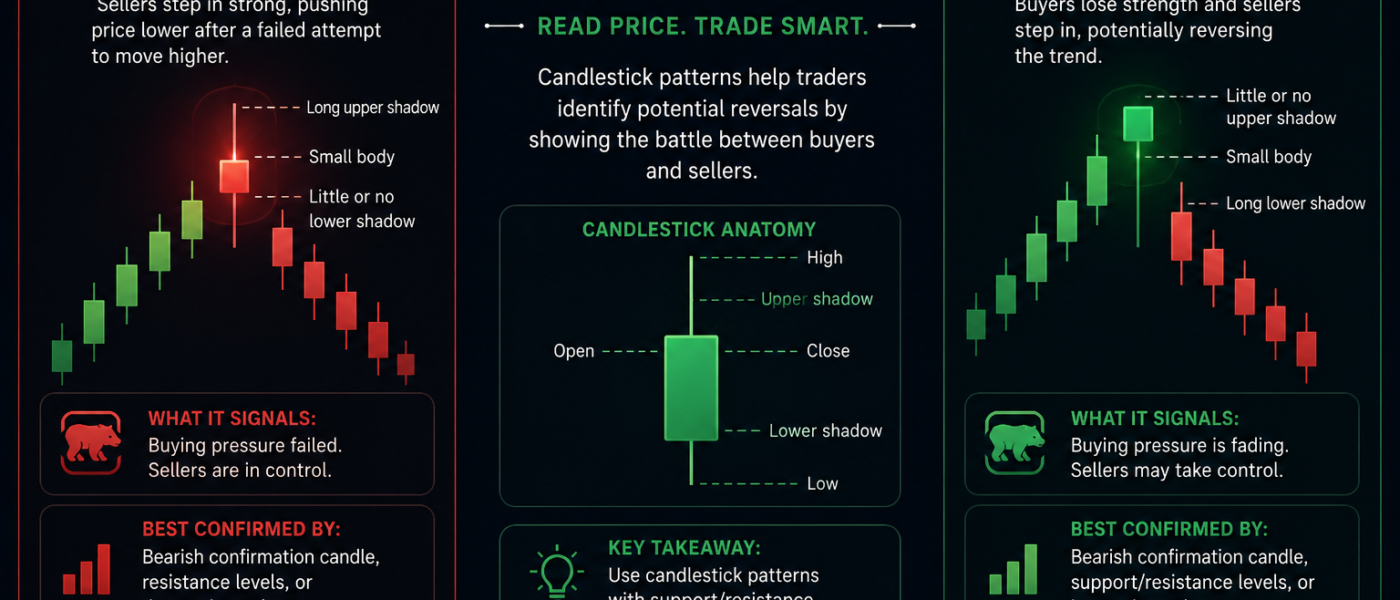
Shooting Stars And Hanging Man Pattern
Identifying Bearish Warning Signs
Candlestick patterns don’t just show where price has been — they often hint at where it may go next. Two of the most widely watched bearish warning signals are the Shooting Star and the Hanging Man.
Both patterns can signal that bullish momentum is weakening and that sellers may be preparing to take control. However, they appear in different market contexts and tell slightly different stories.
Understanding them can help traders identify potential market tops and avoid buying into weakening trends.
What Is a Shooting Star?
A Shooting Star is a single candlestick pattern that appears after an uptrend and signals a potential bearish reversal.
Structure:
- Small candle body near the bottom
- Long upper wick
- Little or no lower wick
What It Means:
The Shooting Star shows that:
- Buyers pushed price significantly higher during the session
- Sellers stepped in aggressively and rejected the higher prices
- Price closed near the opening level, despite the upward move
This suggests that buying momentum is weakening.
Market Psychology Behind the Shooting Star
The Shooting Star tells a clear story of rejection:
- Price is in an uptrend
- Buyers continue pushing higher
- Price spikes upward strongly
- Sellers take control and push price back down
- Candle closes near its low
This creates the visual “shooting star” shape — a sharp move up followed by rejection.
It often appears near resistance zones or after extended rallies, where buyers begin to lose strength.
What Is a Hanging Man?
A Hanging Man looks almost identical to a Hammer, but the context is completely different.
It appears after an uptrend and can signal potential bearish reversal pressure.
Structure:
- Small candle body near the top
- Long lower wick
- Little or no upper wick
What It Means:
The Hanging Man shows that:
- Sellers pushed price sharply lower during the session
- Buyers managed to recover and bring price back up
- But the selling pressure is starting to appear in the market
Even though the candle closes near the top, the strong lower wick reveals growing weakness in the trend
Key Difference Between Shooting Star and Hanging Man
Although they look different visually, both patterns warn of potential bearish reversal — but they show different types of pressure.
| Pattern | Appearance | Key Signal |
| Shooting Star | Long upper wick | Rejection of higher prices |
| Hanging Man | Long lower wick | Emerging selling p |
Both suggest that the uptrend may be losing momentum.
Why These Patterns Matter
Markets rarely reverse without warning. Shooting Stars and Hanging Men often appear when:
- Buyers are exhausted after a strong rally
- Resistance levels are being tested
- Early sellers begin entering the market
- Momentum starts to fade
They act as early warning signs, not guaranteed reversals.
The Importance of Confirmation
One of the biggest mistakes traders make is acting on these patterns alone.
Both Shooting Stars and Hanging Men require confirmation.
Common confirmation signals:
- Next candle closes bearish
- Break of nearby support
- Increased selling volume
- Momentum indicators (like RSI) turning down
For example:
- A Shooting Star forms at resistance
- Next candle drops sharply
- Volume increases
→ stronger bearish signal
Without confirmation, the pattern may fail.
Hanging Man vs Hammer (Common Confusion)
The Hanging Man looks identical to a Hammer, but the difference is context:
- Hammer → appears after a downtrend (bullish reversal)
- Hanging Man → appears after an uptrend (bearish warning)
Same shape, completely different meaning.
This is why trend context is critical in candlestick analysis.
Where These Patterns Appear Most Often
Shooting Stars and Hanging Men are most effective when they form near:
- Key resistance levels
- Trendline resistance
- Previous market highs
- Overbought conditions
- Extended rallies
These are areas where profit-taking and reversals often occur.
Common Mistakes Traders Make
1. Ignoring Trend Context
A Shooting Star is only meaningful after an uptrend. In sideways markets, it may be noise.
2. Trading Without Confirmation
Jumping in immediately can lead to false signals and losses.
3. Overlooking Volume
Weak volume reduces the reliability of the pattern.
4. Confusing Hammer and Hanging Man
They look identical — only the trend context defines them.
Combining With Other Tools
These patterns are much stronger when combined with:
- Resistance zones (key reversal areas)
- Trendlines (momentum structure)
- Volume analysis (confirmation strength)
- RSI divergence (overbought conditions)
- Candlestick follow-through
Example setup:
- Price hits resistance
- Shooting Star forms
- RSI is overbought
- Volume spikes
- Next candle turns bearish
This combination increases probability of a reversal
Shooting Stars and Hanging Man are powerful warning signals that often appear near the end of uptrends. They reveal moments where buying pressure is fading and sellers may be starting to take control.
The Shooting Star shows clear rejection of higher prices, while the Hanging Man highlights early signs of selling pressure despite a bullish close.
Neither of the Shooting Stars And Hanging Man pattern guarantees a reversal on its own, but when confirmed with trend context, volume, and key levels, they become valuable tools for identifying potential market tops.
