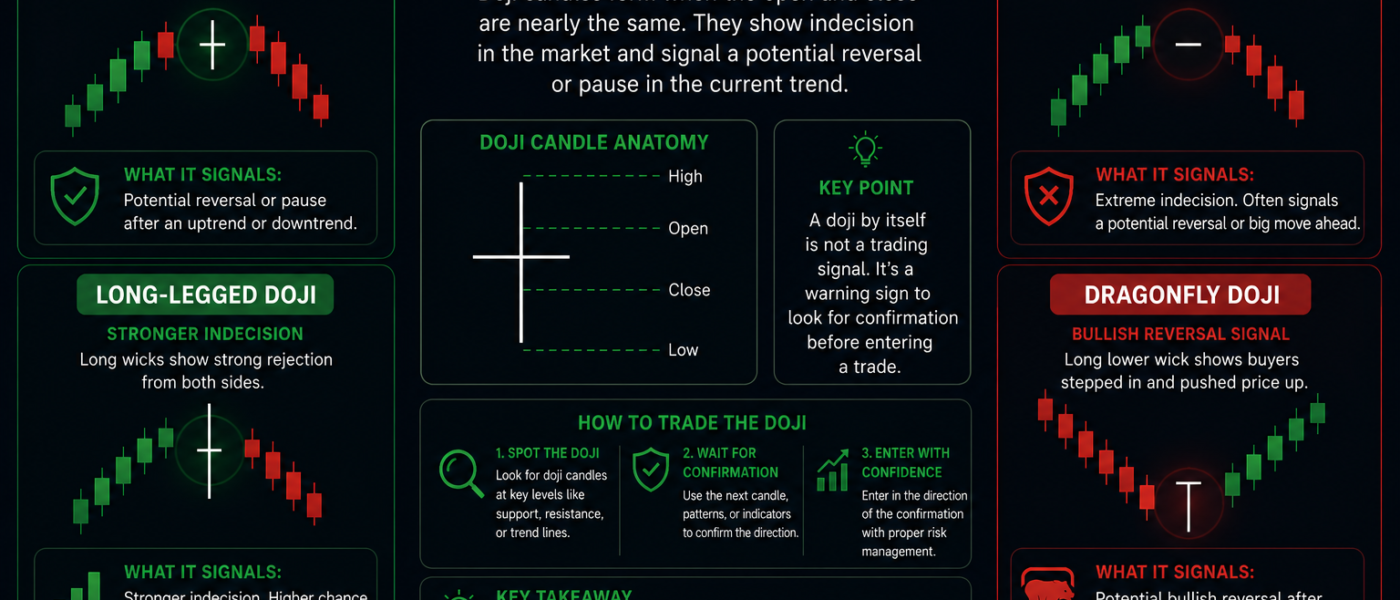
The Doji Family
Candlestick charts don’t just show where price has been — they also reveal the battle between buyers and sellers. One of the clearest examples of this is the Doji family, a group of candlestick patterns that signal market indecision.
A Doji forms when the opening and closing price are almost exactly the same. This creates a very small (or sometimes non-existent) candle body, with wicks showing price movement during the session.
In simple terms, a Doji means: “Neither buyers nor sellers fully won this period.”
Because of this balance, Doji candles often appear near potential turning points in the market.
What Is a Doji Candlestick?
A basic Doji has:
- A very small or invisible body (open ≈ close)
- Upper and lower wicks showing price movement
- A sense of “pause” in market direction
Even though price may have moved up and down during the period, it ultimately closed near where it opened. This reflects uncertainty and indecision. Not all Dojis look the same. The “Doji family” includes several variations, each with slightly different meaning depending on context.
The Standard Doji
The standard Doji is the most neutral version and it suggests:
- Market indecision
- Balance between buyers and sellers
- Potential pause in trend momentum
On its own, a Doji does not predict direction. Instead, it tells traders that the current trend may be losing strength.
For example:
- In a strong uptrend, a Doji may signal buyers are slowing down.
- In a strong downtrend, a Doji may suggest sellers are losing control.
The key is where it appears, not just the shape itself.
The Long-Legged Doji
A Long-Legged Doji has very long upper and lower wicks with a small body in the centre.
This shows that:
- Buyers pushed price significantly higher
- Sellers pushed price significantly lower
- But neither side maintained control
This pattern represents extreme indecision and volatility. It often appears during periods of uncertainty, such as:
- News events
- Market hesitation before major moves
- Exhaustion in strong trends
It can signal that a big move may follow, but direction is not yet confirmed.
The Dragonfly Doji
The Dragonfly forms when:
- Price opens and closes near the high of the session
- A long lower wick is visible
- Little or no upper wick exists
This shows that sellers pushed price sharply down, but buyers aggressively pushed it back up to the opening level. In many cases, the Dragonfly Doji can signal a potential bullish reversal, especially when it appears after a downtrend.
It suggests:
- Strong rejection of lower prices
- Buyer strength returning
- Possible support forming
The Gravestone Doji
The Gravestone Doji is the opposite of the Dragonfly Doji.
It forms when:
- Price opens and closes near the low of the session
- A long upper wick is present
- Little or no lower wick exists
This shows that buyers pushed price higher during the session, but sellers overwhelmed them and forced price back down. In many cases, this can signal a potential bearish reversal, especially after an uptrend.
It suggests:
- Buyer exhaustion
- Strong selling pressure
- Possible resistance forming
Why Doji Patterns Matter
Doji candles are important because they represent a shift in momentum or hesitation in trend direction.
Markets do not move in straight lines. They move through phases of:
- Momentum
- Exhaustion
- Consolidation
- Reversal
Doji patterns often appear during transitions between these phases.
However, a Doji alone is not a trade signal. It is a warning sign that something may be changing.
Context Is Everything
The most important rule with Doji candles is this:
A Doji is only meaningful in context.
For example:
- In a strong uptrend → a Doji may signal weakening momentum
- In a strong downtrend → a Doji may signal selling exhaustion
- In sideways markets → Dojis may simply reflect normal noise
Traders always look at the surrounding trend before interpreting the signal.
Confirmation Is Crucial
Because Dojis represent indecision, traders often wait for confirmation before acting.
Confirmation may include:
- Next candle direction (break above or below Doji range)
- Increased volume
- Break of support or resistance
- Momentum indicators (like RSI shifting direction)
For example:
- A Dragonfly Doji at support
- Followed by a strong bullish candle
- With rising volume
This combination may suggest a stronger reversal signal.
Doji and Market Psychology
Doji patterns reflect a psychological “tug of war”:
- Buyers push price one way
- Sellers push it back
- Neither side gains full control
This battle often happens near key decision points in the market, such as:
- Support levels
- Resistance zones
- Trendlines
- Major news events
That’s why Dojis are often seen before significant price movements.
The Doji family is one of the clearest visual representations of market indecision. Whether it’s a standard Doji, Long-Legged Doji, Dragonfly, or Gravestone, each pattern tells a story of uncertainty between buyers and sellers.
While the Doji family do not guarantee reversals, they often appear at important turning points where momentum is shifting. When combined with trend analysis, support and resistance, and volume confirmation, Doji patterns become a powerful tool for understanding when the market may be preparing for its next move.
