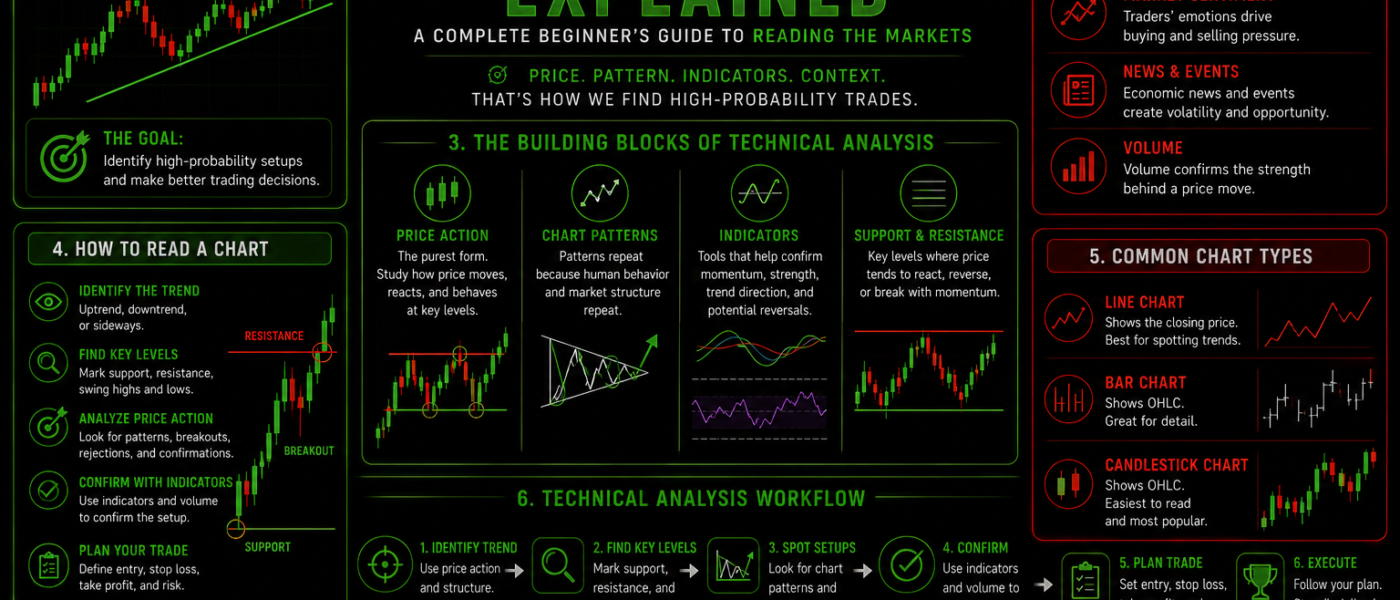
Technical Analysis Explained: A Complete Beginner’s Guide to Reading the Markets
Technical analysis is one of the most widely used methods for analysing financial markets. Whether you trade stocks, cryptocurrencies, forex, commodities, or indices, technical analysis provides a framework for understanding price movements and identifying potential trading opportunities.
Unlike fundamental analysis, which focuses on economic data, company earnings, and broader market conditions, technical analysis studies price action itself. The core belief behind technical analysis is simple: everything that affects an asset’s value is ultimately reflected in its price.
For beginners charts can often appear confusing. Candlesticks, indicators, trend lines, support zones, resistance levels, and volume bars may seem overwhelming at first. However, once the basic principles are understood, along with the foundations of trading , technical analysis can become a powerful tool for making informed trading decisions.
What Is Technical Analysis?
Technical analysis is the study of historical price movements to forecast future market behaviour.
Technical analysts examine charts and patterns to identify trends, momentum, and potential reversal points. The goal is not to predict the future with certainty but to increase the probability of making successful trading decisions.
The practice is built on three key assumptions:
1. The Market Discounts Everything
Technical analysts believe that all available information is already reflected in the current market price. News, economic events, investor sentiment, and market expectations are all incorporated into price action.
2. Prices Move in Trends
Markets rarely move randomly. Instead, they tend to develop trends that continue until a significant event or shift in sentiment occurs.
These trends can be:
- Uptrends
- Downtrends
- Sideways ranges
Recognising these trends is one of the most important skills a trader can develop.
3. History Tends to Repeat Itself
Human emotions such as fear and greed have influenced markets for centuries. Because human behaviour remains relatively consistent, similar chart patterns and market momentum often appear repeatedly. This is why patterns such as double tops, double bottoms, and head and shoulders formations continue to be studied today.
Understanding Price Charts
Charts are the foundation of technical analysis.
While several chart types exist, candlestick charts are the most popular among traders. Each candlestick represents a specific period of time and displays four important pieces of information:
- Opening price
- Closing price
- Highest price
- Lowest price
A bullish candlestick typically closes above its opening price, while a bearish candlestick closes below its opening price.
By analysing groups of candlesticks together, traders can gain insights into market sentiment and potential future price movements.
The Importance of Trends
Understanding trend lines is a fundamental skill for investors to try to attain as soon as they can .The phrase “the trend is your friend” is one of the most famous sayings in trading. Markets generally move in one of three directions:
Uptrend
An uptrend is characterised by higher highs and higher lows. Buyers remain in control, and price continues to move upward over time.
Downtrend
A downtrend consists of lower highs and lower lows. Sellers dominate the market, pushing prices lower.
Sideways Market
Sometimes markets move within a range without establishing a clear trend. During these periods, price often bounces between support and resistance levels. Learning to identify the current market trend helps traders align their strategies with prevailing market conditions.
Support and Resistance
Support and resistance are among the most important concepts to learn in technical analysis.
Support
Support is a price level where buying pressure tends to emerge, preventing prices from falling further. When price approaches support, traders often look for signs that buyers are stepping back into the market.
Resistance
Resistance is a level where selling pressure tends to increase, preventing prices from rising further. As price approaches resistance, traders watch for evidence that sellers are becoming active. Support and resistance levels are valuable because they often influence future market behaviour.
Volume: The Fuel Behind Price Movements
Volume measures the number of shares, contracts, or coins traded during a given period. Many experienced traders consider volume one of the most important indicators available. Strong volume can confirm a trend, while weak volume may suggest that a move lacks conviction.
For example:
- Rising prices with increasing volume often indicate strength.
- Rising prices with declining volume may signal a weakening trend.
- Sharp increases in volume can precede breakouts or reversals.
Understanding volume helps traders evaluate the quality of a price move rather than focusing solely on price itself.
Technical Indicators
Indicators are mathematical calculations based on price and volume data. They help traders identify trends, momentum, volatility, and potential entry or exit points.
Some of the most popular indicators include:
Relative Strength Index (RSI)
RSI measures momentum and helps identify overbought or oversold conditions. Many traders view readings above 70 as potentially overbought and readings below 30 as potentially oversold.
Moving Averages
Moving averages smooth price data to help identify the underlying trend.
Common examples include:
- 20-period moving average
- 50-period moving average
- 200-period moving average
Read our moving average strategy guide
MACD
The Moving Average Convergence Divergence (MACD) indicator helps traders identify trend strength and momentum shifts. Indicators should never be used in isolation. They work best when combined with price action and market structure analysis.
Risk Management Matters More Than Prediction
One of the biggest mistakes new traders make is focusing entirely on finding the perfect entry. Successful trading is often more about managing risk than predicting market direction.
Key risk management principles include:
- Using stop-loss orders
- Limiting risk per trade
- Maintaining a favourable risk-to-reward ratio
- Avoiding emotional decisions
- Following a trading plan
Even the best technical analysts experience losing trades. Risk management helps ensure that losses remain manageable while allowing winning trades to grow.
Building Your Technical Analysis Skills
Learning technical analysis is a process that takes time and practice.
A sensible learning path includes:
- Understanding candlestick charts
- Learning trend identification
- Mastering support and resistance
- Studying volume analysis
- Exploring indicators
- Practising risk management
- Developing a trading strategy
The goal is not to memorise every indicator or chart pattern. Instead, focus on understanding how markets behave and learning to interpret price action objectives .
Technical analysis are the foundation of trading provides traders with a structured way to analyse financial markets and make informed decisions. By studying price action, trends, support and resistance levels, by understanding volume, and indicators, traders can better understand market behaviour and identify high-probability trading opportunities.
No method guarantees success, but technical analysis explained still remains one of the most valuable tools available to traders. The key is to combine technical knowledge with discipline, patience, and sound risk management. As your skills develop, technical analysis becomes less about predicting the market and more about understanding probabilities, managing risk, and consistently executing a proven trading plan.