What The Candles Are Telling You
If you have ever looked at a trading chart, you’ve probably noticed the red and green candles moving across the screen. To a beginner, they may appear random and confusing. Experienced traders know that candlesticks tell a story.
Every candle represents a battle between buyers and sellers, and learning to read that story can provide valuable insight into market sentiment.
Candlestick charts are one of the most popular tools in technical analysis because they reveal far more information than a simple line chart. They show where price opened, where it closed, how high it traded, and how low it fell during a specific period.
Understanding what the candles are telling you can help you identify trends, spot reversals, and make more informed trading decisions.
Understanding the Anatomy of a Candle
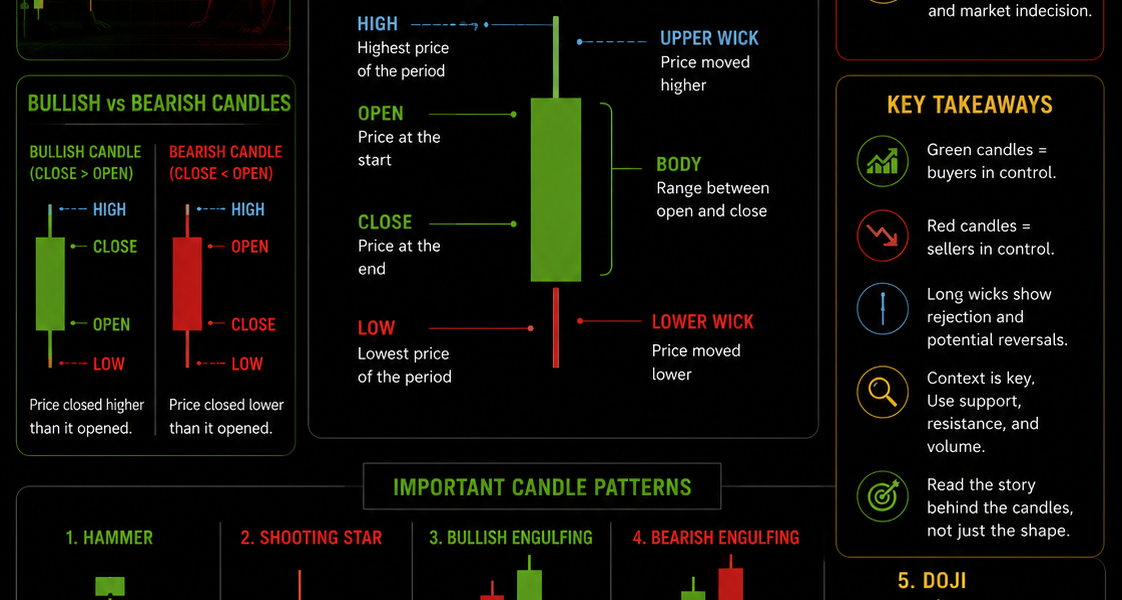
Before interpreting candlesticks, it is important to understand their structure. Each candle consists of a body and one or two wicks, sometimes called shadows.
The body represents the difference between the opening and closing price during the selected time period.
A green candle typically means the closing price was higher than the opening price, indicating buyers were in control. A red candle usually means the closing price was lower than the opening price, showing sellers had the upper hand.
The wicks show the highest and lowest prices reached during that period before the candle closed. Every candle is a snapshot of market psychology.
Large Green Candles Show Strong Buying Pressure
When you see a large green candle with a strong body and little or no upper wick, it often signals aggressive buying activity. Buyers entered the market and continued pushing prices higher throughout the session.
These candles frequently appear during strong uptrends and can indicate confidence among market participants.
However, context matters. A large green candle after a prolonged rally may also suggest excitement is reaching extreme levels. In some cases, overly aggressive buying can lead to short-term pullbacks as traders take profits.
The key is to view the candle within the overall market structure rather than in isolation.
Large Red Candles Reveal Selling Strength
Just as large green candles indicate buying pressure, large red candles often reveal strong selling activity.
A long red candle suggests sellers dominated the session and pushed prices lower with little resistance from buyers. These candles are common during downtrends and periods of market fear.
When multiple large red candles appear consecutively, it often signals strong bearish momentum. Traders may become increasingly cautious, and some investors may rush to exit positions.
Again, context is crucial. A large red candle at the end of a long decline may indicate panic selling, which can sometimes occur near market bottoms.
Long Wicks Tell an Important Story
Wicks are often overlooked by new traders, but they can provide valuable clues about market sentiment.
A long lower wick suggests sellers pushed prices lower during the session, but buyers stepped in and forced price back up before the candle closed.
This can be a sign that demand exists at lower levels.
A long upper wick tells the opposite story. Buyers pushed prices higher, but sellers eventually took control and drove prices back down.
This often indicates resistance and weakening buying momentum.
When long wicks appear near important support or resistance levels, traders pay close attention because they can signal potential turning points.
The Hammer: A Potential Reversal Signal
One of the most recognised candlestick patterns is the hammer pattern.
A hammer forms when a candle has a small body near the top of its range and a long lower wick.
This pattern shows that sellers initially pushed the market sharply lower, but buyers regained control before the close.
The result is a candle that resembles a hammer.
When a hammer appears after a decline, it may indicate that selling pressure is weakening and buyers are beginning to step in.
While not every hammer leads to a reversal, it often serves as an early warning that sentiment may be changing.
The Shooting Star: A Warning for Bulls
The shooting star is essentially the opposite of the hammer.
It forms when a candle has a small body near the bottom of its range and a long upper wick.
This tells us that buyers pushed prices significantly higher during the session, but sellers eventually overwhelmed them and forced prices back down.
When a shooting star appears after an extended uptrend, it can signal that bullish momentum is fading.
Many traders use this pattern as a warning sign that a pullback or reversal could be approaching.
Candles Work Best with Context
One of the biggest mistakes beginners make is relying on a single candle pattern to make trading decisions.
No candle guarantees a market move.
A hammer in the middle of a strong downtrend may fail. A shooting star during a powerful bull market may be ignored by buyers.
This is why successful traders combine candlestick analysis with other tools such as support and resistance, volume, trend lines, and momentum indicators.
The more evidence supporting a trade idea, the greater the probability of success. Candles provide clues, but they should not be treated as certainty.
Reading the Story Behind Price
The real value of candlestick analysis comes from understanding the story behind the chart. Every candle represents a battle between buyers and sellers.
Large green candles show strength. Large red candles reveal weakness. Long wicks expose rejection. Reversal patterns highlight shifts in market sentiment.
Instead of memorising dozens of candlestick patterns, focus on understanding what the market participants were doing during the formation of each candle.
Ask yourself:
- Who was in control?
- Did buyers or sellers gain the upper hand?
- Was there rejection at key levels?
- Is momentum increasing or fading?
These questions will often provide more insight than simply recognising a pattern name.
Candlesticks are one of the most powerful tools available to traders because they provide a visual representation of market psychology. They show the ongoing battle between fear and greed, buyers and sellers, optimism and uncertainty.
By learning to read the story behind the candles, traders can gain a deeper understanding of market behaviour and improve their decision-making process.
The next time you open a chart, don’t just look at the candles. Listen to what they are telling you. The market leaves clues every day, and those who learn to read them gain a valuable edge.
